How Do You Build an AI-Powered Marketing Agency?
You start by automating the work you already do every day, not by buying tools and hoping they connect.
The agencies winning right now are not selling AI services to clients. They are using AI to run their own operations.
Reporting, client updates, campaign analysis. Pocketing the margin they used to spend on headcount.
That is the difference between an AI-powered agency and an agency that talks about AI.
On a Tuesday morning a few months ago, I dropped one file into Claude and walked away to make coffee.
When I came back, it had pulled my Fireflies transcript from the night before. Updated my roadmap. Created a to-do list.
Scraped industry news. Drafted three LinkedIn posts in my voice.
I am not a coder. I built that workflow by describing it to an AI in plain English.
That morning changed how I think about running a marketing agency.
What AI Agency Automation Actually Means
Most articles about building an AI marketing agency focus on how to sell AI services to clients.
That is not what this is about.
AI agency automation means using AI to run the internal operations of your own agency. The work nobody charges for but everyone does. Weekly reports, campaign summaries, client update emails.
When you automate that work, two things happen. You get those hours back. And your margin goes up without raising your prices.
That is how a small team competes with a 50-person agency. Not by hiring faster. By building smarter.
Where Do You Start With Agency Automation?
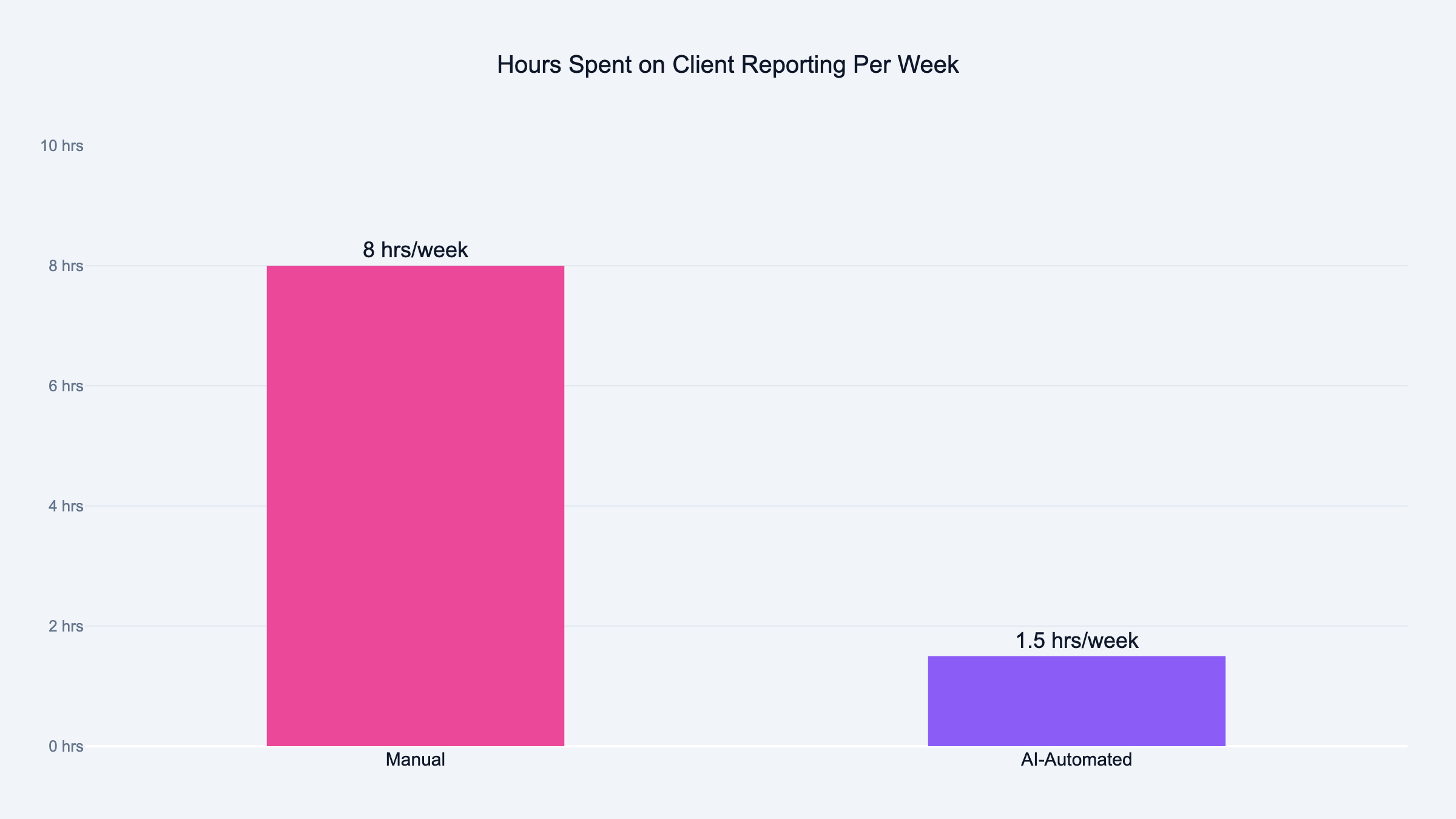
I start with the task my team dreads most that follows the same pattern every week. For us, that was client reporting. Victor used to spend two full days pulling numbers from Meta, Google, and spreadsheets. Same format, same process, every single week. That is the perfect first automation target.
The first thing I look for is a task that happens every week and follows the same pattern every time.
It has to take more than an hour. And it has to be something my team dreads doing.
For most agencies, that task is client reporting. Victor my co-founder used to spend the first two days of every week pulling numbers. Meta, Google, spreadsheets.
One report per client. Same format. Every week. I wrote a step-by-step guide on automating client reporting with AI that covers the full process.
That is your starting point.
Not the creative work. Not the strategy calls. The reporting.
Start there because it is predictable enough for AI to handle. And painful enough that your team actually wants it solved.
The tasks to automate first:
-
Weekly client reports: Same structure every time. Pull data, format, send. AI handles all three steps.
-
Campaign performance summaries: Take raw numbers and write a plain-English explanation. What went up, what went down, what to do next week.
-
Client update emails: Same questions every week. AI drafts the response in your voice using real campaign data.
-
Onboarding documents: Every new client gets the same pack. Automate the generation, personalize the details.
Stay away from creative strategy and positioning for now. AI needs a pattern. If you cannot describe the task in one paragraph, it is not ready to automate. Once your workflows are stable, turn them into AI SOPs for your agency so any team member can run them. If you want to go further, I documented how I built an AI brain for my agency using Claude Code — a full knowledge base and skill system that runs operations end to end.
What Is the Right AI Agency Tech Stack?
The right AI agency tech stack is whatever works now for your team and clients. At Sucana, I run Fireflies for meeting capture, Claude for AI reasoning and drafting, Claude Code and Make.com for automation, and Sucana for campaign data. The tools matter less than choosing what to automate first.
There is no perfect AI tech stack for agencies. There is only what works now, for your team, with your clients.
Here is what I run at Sucana.
For meeting capture: Fireflies. Every call gets transcribed automatically. I have not taken a manual note in months.
For the AI brain: Claude. I use it for drafting emails, building automation workflows, and analyzing campaign data. Most of what I built, I built by describing what I wanted in plain English.
For connecting tools: Claude Code for complex workflows. Make.com for simpler ones. When a task maps cleanly in a flowchart, Make.com handles it. When it needs judgment mid-flow, Claude Code does.
For campaign data: Sucana pulls performance data from Meta and Google automatically. Victor my co-founder gets a full analysis every morning without touching a spreadsheet.
For a full comparison of what is available, see my review of AI marketing automation tools. The tech stack is not the hard part. The hard part is choosing what to automate first.
How to Set Up AI Automation for Your Agency
This is the process I follow every time I add a new automation at Sucana. For the full breakdown of costs, risks, and which task to pick first, see my guide on AI automation for marketing agencies.
First, I write the task down in plain English. Not in any tool. Just a notes document.
What happens first, what data it needs, what the output looks like, who receives it.
Then I open Claude and paste that description in. I tell it what I am trying to build.
It asks me questions. I answer them.
That conversation becomes the working spec. I do not need to know how to code. I just need to know what I want.
Then I build the simplest version that works. Not the perfect version. The one that does 80% of the job this week.
I run it once manually and check the output. If it looks right, I let it run two more times. If it holds, it becomes part of the standard workflow.
Why Most Agency Automation Projects Fail
The marketing automation failure rate is high. Around 73% of projects break down. The cause is almost always the same.
Teams build the automation and walk away.
The workflow runs fine on launch day. Then an API updates. A data format shifts.
A media buyer uses "RT" instead of "retargeting" in a campaign name. The filter breaks. Nobody notices until a client asks a question that does not match the numbers.
I review every automation once a month. Not deeply. Fifteen minutes per workflow.
I check that outputs still make sense and data is coming through clean. That one habit is the difference between automation that compounds and automation that quietly breaks.
How to Scale a Marketing Agency Without Hiring
The question I get most from other agency founders: how do you take on more clients without burning out your team?
The answer is not a better project management tool.
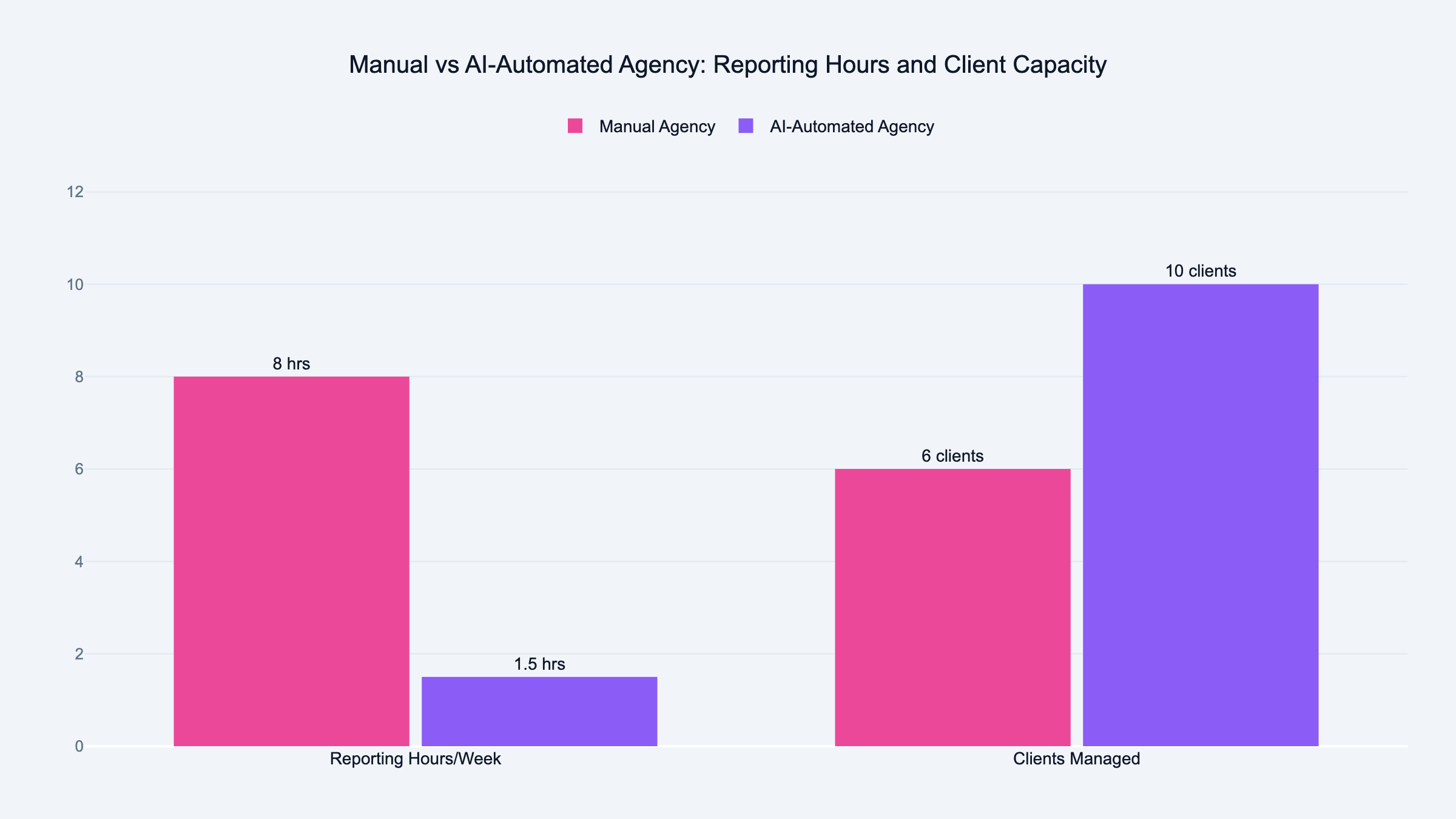
The real bottleneck is time spent on tasks that do not require human judgment. When I automated client reporting at Sucana, I did not cut headcount. I redirected the time. The research on whether AI is replacing marketers shows most agencies are doing the same.
The hours that used to go into pulling numbers went into improving creative and talking to clients.
Victor my co-founder now manages more client accounts than he did twelve months ago. We did not hire more media buyers. We automated the administrative layer of his week.
That is how you scale a marketing agency without hiring. Automate the repeatable layer. Free your team for the judgment layer. When you are ready to sell that capacity to new clients, I wrote a guide on pitching AI services to agency clients that covers the sales process.
What to Automate Last
There is a version of this where you over-automate and it costs you clients.
I know agency owners who automated their entire client communication flow. Every email, every check-in, every update. Clients noticed.
They felt like they were talking to a system, not a partner. Two of them churned.
The rule I follow: automate the backend, keep the relationship human.
Automated reports are fine. Automated strategy calls are not.
Automated data summaries are fine. Automated responses to a client panic are not.
The client pays for your judgment. They pay for the call where you explain what the numbers mean and what you are doing about it. No automation replaces that conversation.
Keep humans in the moments that matter. Let the machine handle everything else.
Frequently Asked Questions
What is AI agency automation?
AI agency automation means using AI tools to handle the repeatable, data-driven tasks inside a marketing agency. Things like generating client reports, writing campaign summaries, and drafting update emails.
The goal is to free up your human team for judgment work, not just time-consuming work.
How much can AI reduce marketing agency costs?
It depends on what you automate. At Sucana, automating client reporting freed up roughly 6 to 8 hours per week per account.
Two hours per client per week, 10 clients: that is 20 hours saved weekly. You can take on 2 to 3 more clients with the same team.
Can a small agency compete with large AI-powered agencies?
Yes. AI levels the ops side of the business.
A two-person team with automated reporting can move as fast as a 10-person team without it. The margin is better too.
What are the biggest mistakes agencies make with marketing automation?
Set-and-forget is the most common mistake. Build the workflow, walk away, watch it quietly break. Nobody notices.
The second mistake is automating too much too fast. Start with one workflow, get it solid, then add the next.
Agencies that try to automate everything at once end up with five broken workflows instead of one working one.
Why do marketing automation projects fail?
The 73% failure rate mostly comes from two places: bad data and no monitoring.
If your campaign data is messy or inconsistently named, the automation produces wrong outputs. And if nobody checks the workflow regularly, errors compound for weeks.
Fix the data first. Then build the automation. Then build the monitoring habit.
The tools I see most: Claude for AI reasoning, Make.com or Zapier for automation, and Fireflies for meeting transcription.
The combination matters more than any individual tool. You need three things: input capture, AI processing, and output delivery to the right place.
What is the difference between AI agents and traditional marketing automation?
Traditional automation follows a rigid script. If A happens, do B. No flexibility.
AI agents handle variability. They can read a campaign summary, find the key insight, and write a client email that addresses it. A standard Zapier flow cannot do that.
The more judgment a task requires, the more you need an AI agent.
The fastest way is to build one working workflow and let them use it for two weeks.
I never start with training. I start with a result. I cover the full process in my marketing team AI adoption strategy. Once Victor my co-founder saw the report running automatically, he started asking what else we could automate.
How do you automate without losing the client relationship?
You automate the data and the formatting. You keep the human on the conversation.
Automated reports are fine. The email where you explain what the numbers mean should still come from you.
Clients do not pay agencies for data. They pay for someone who knows what to do with it.
How do you measure ROI on marketing automation for agencies?
I track two things: time saved per week and revenue per team member.
Time saved is easy to measure. Revenue per team member is the better long-term signal. If revenue grows and headcount stays flat, the automation is working.
Do not try to calculate precise ROI in month one. Run the automation for 90 days, then look at what changed.
Is AI agency automation only for large agencies?
No. Small agencies benefit more, not less.
A large agency absorbs inefficiency with headcount. A small agency cannot.
Automate reporting, and it changes the economics of your whole business. Even with a team of two.
What should I automate first as a new agency owner?
Client reporting, without question. It is the most predictable task in the agency business. Same data, same format, same output, every week.
Once that runs automatically, add campaign performance summaries. Then client update emails.
Build one at a time, in that order. You will have a working AI operations layer within 60 days.