Pick the biggest time waster first. Find one tool that fixes it. Get it working before you add anything else.
Stacking five tools at once is how you end up with five half-configured tools and zero working automations. I wrote a step-by-step guide on building AI workflows for your marketing team that covers this approach.
Connect tools only when both work on their own.
I see agencies buy n8n on day one. They try to connect tools that do not work yet.
Make sure each tool produces good output alone first. Then connect them.
Budget for the real cost, not the subscription price.
The subscription is $30 a month. The setup time is 8 hours. The learning curve is 2 weeks.
The real cost of an AI tool is time, not money. Factor that in before you commit. Knowing which tools to learn first matters, and I covered the AI skills every marketer needs in a separate post.
What Separates Tools That Stick From Tools That Get Dropped
After a year of testing, I see three patterns in tools that survive past the first month.
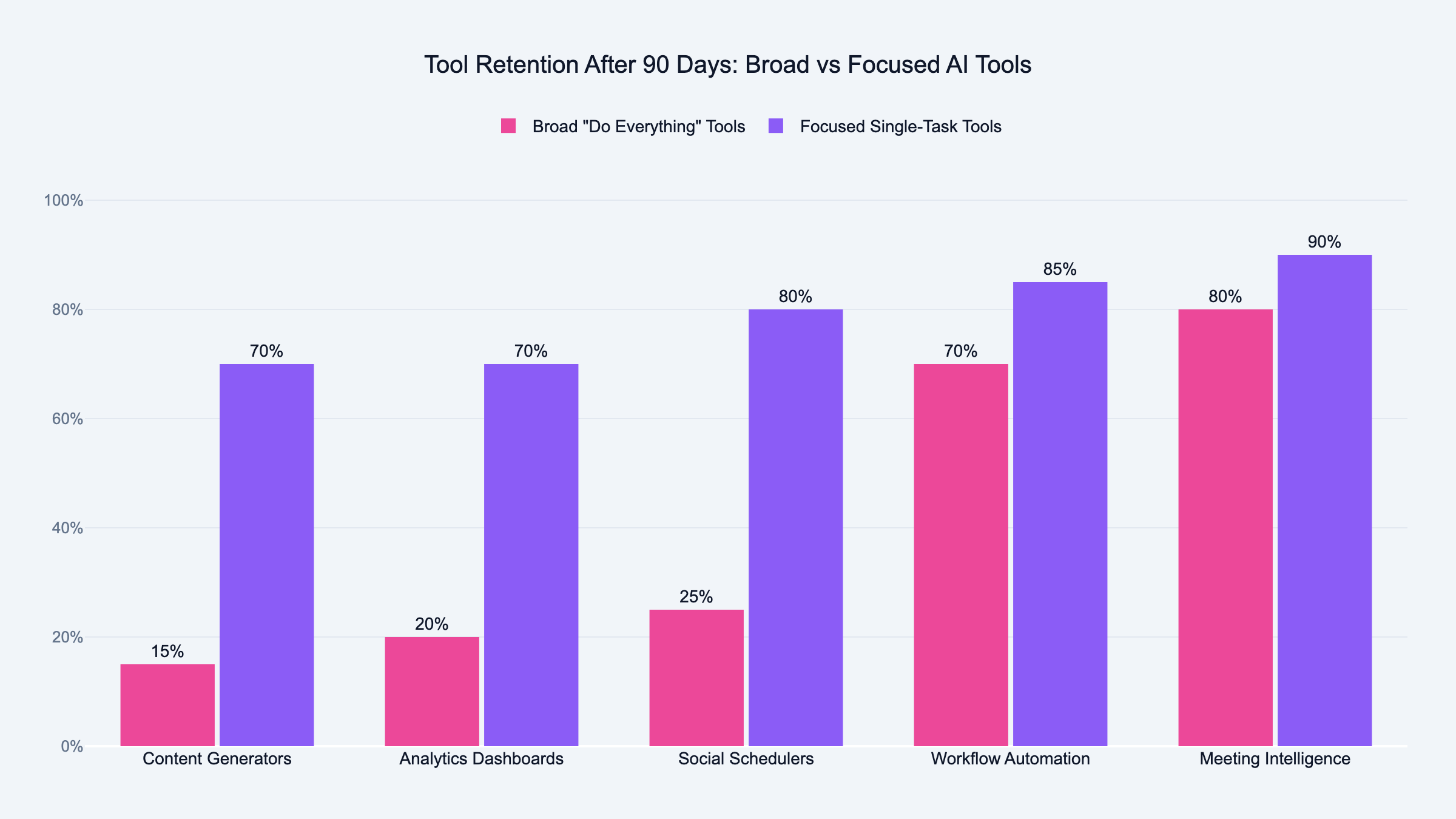
They solve one problem clearly. Claude does AI conversations with context. n8n does workflow connections.
Fireflies does meeting transcription. None of them tries to be everything.
They produce output I can use without heavy editing. If I rewrite 80% of what the tool gives me, it is not saving time. It is adding a step.
They get better as I use them more. Claude improves because I add more context files. n8n gets faster because I refine my workflows.
Tools that stay flat no matter how much I invest get dropped.
The Real Cost of Chasing Every New AI Tool
I wasted three months in early 2025 trying every AI marketing tool that launched. A different tool every week.
A fresh setup every weekend. Another disappointment every Monday.
The cost was not just the subscriptions. It was the context switching.
Every time I moved to a new tool, I lost the context I had built. My prompts, my workflows, my configurations. All gone.
Now I have a rule. I only evaluate a new tool when an existing workflow breaks. If everything is running, I do not touch it.
Boring is good.
Frequently Asked Questions
What AI marketing automation tools actually work in 2026?
The tools that work automate specific, repeatable weekly tasks. Claude for content and analysis, n8n for workflows, Fireflies for meeting intelligence.
Generic "do everything" platforms tend to underdeliver. Pick tools that solve one problem well.
Are AI marketing tools worth the money or overhyped?
Some are worth every penny. Others are pure hype.
The difference comes down to whether the tool replaces a task you do manually every week. If you cannot name the exact task, it is probably overhyped.
How do I automate marketing workflows with AI?
Track your time for one week. Find the tasks that take more than 30 minutes and happen more than once.
Pick the biggest time waster first. Find one AI tool that handles it. Get it working before adding more tools.
What is the difference between traditional marketing automation and AI automation?
Traditional marketing automation follows rules you set. If X happens, do Y. AI automation interprets context and makes decisions.
Ask it to summarize a call, and it pulls out the important parts. You do not need to define what "important" means. That is the practical difference.
Which AI tools replace manual marketing tasks?
Claude replaces content drafting, data analysis, and research. n8n replaces data transfers between platforms. Fireflies replaces note-taking.
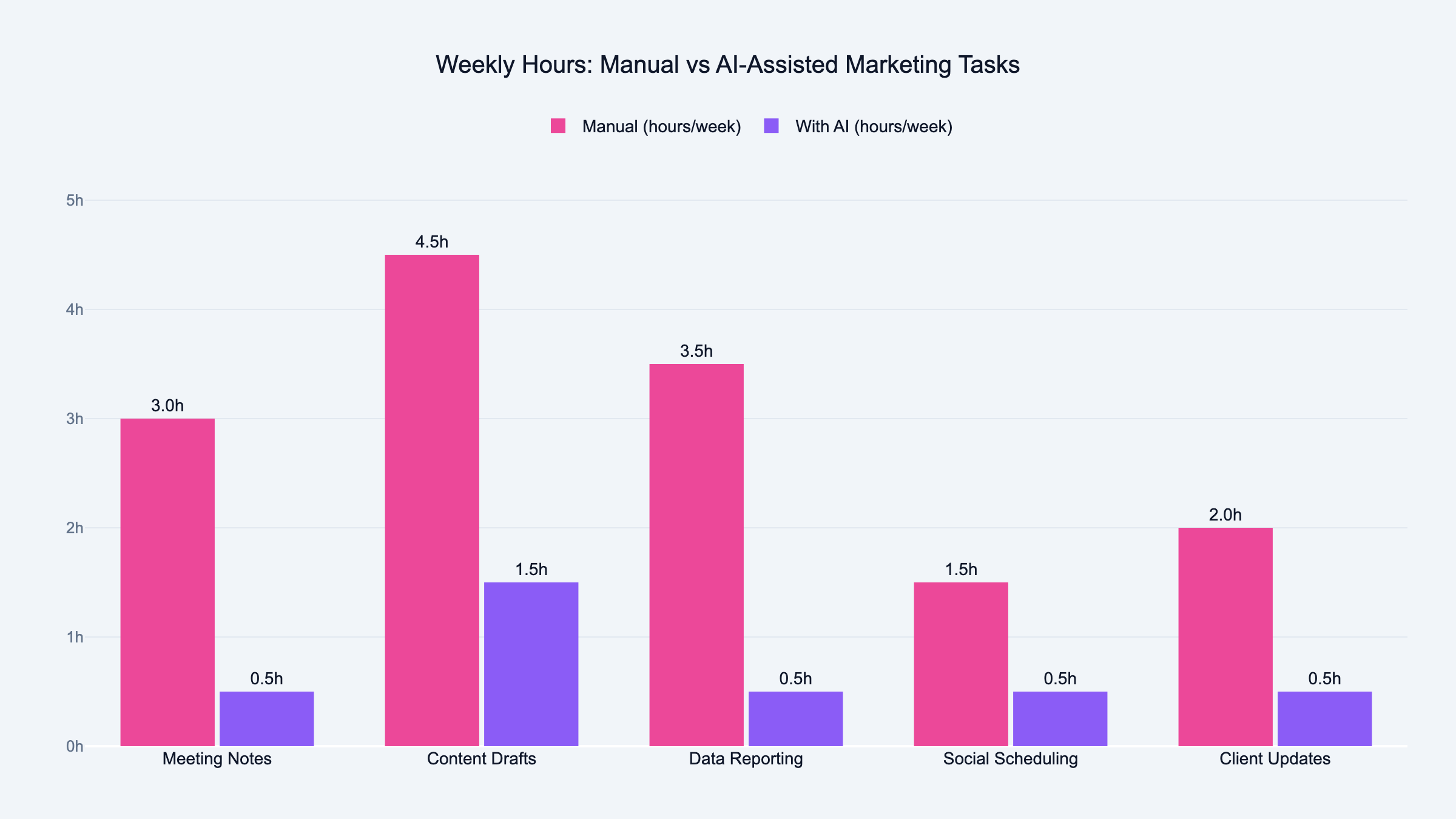
Together they cut about 12 hours per week from my workload. No single tool replaces everything.
How much do AI marketing automation tools cost?
Claude Pro costs $20 per month. n8n self-hosted is free. Fireflies starts at $10 per month.
My entire AI stack runs under $100 per month. The real cost is setup time, not subscription fees. Budget 8 to 16 hours per tool.
Can AI replace a marketing team?
AI replaces tasks, not people. I still make every strategic decision. I still approve every piece of content.
What AI does is free up the 12 hours per week I used to spend on repetitive work. That time now goes into strategy and building Sucana.
What marketing tasks should you automate with AI first?
Reporting, meeting notes, and content drafts. These three are repeatable, structured, and time-consuming. They also have the lowest risk if AI makes a mistake.
Do not start with creative strategy or client communication. Those need human judgment that AI cannot match yet.
How do I integrate AI tools with my existing marketing stack?
Use n8n or Make.com as the connection layer. These tools bridge your AI tools and your existing platforms.
Start with one connection. Test it for a week. Add the next connection only after the first one runs clean.
What are the biggest mistakes teams make with AI marketing automation?
Buying too many tools at once. Automating tasks that do not need it. Expecting perfect output without any editing.
The biggest mistake is treating AI tools as magic. They need setup, context, and maintenance, just like every other tool. I wrote about building an AI-powered marketing agency that covers how to avoid these mistakes at scale.