How Do You Pitch AI Services Without Sounding Like Every Other Agency?
You pitch the outcome, not the technology. Nobody cares about your n8n workflows or your Claude prompts. They care about the 6 hours a week their team wastes on reporting.
A mentor of mine, Ben, runs an AI agency. He told me something that changed how I think about selling AI: "Your first project is not about cashing in. It is about showing one win as fast as possible."
That stuck with me.
What Does a Good AI Sales Process Look Like?
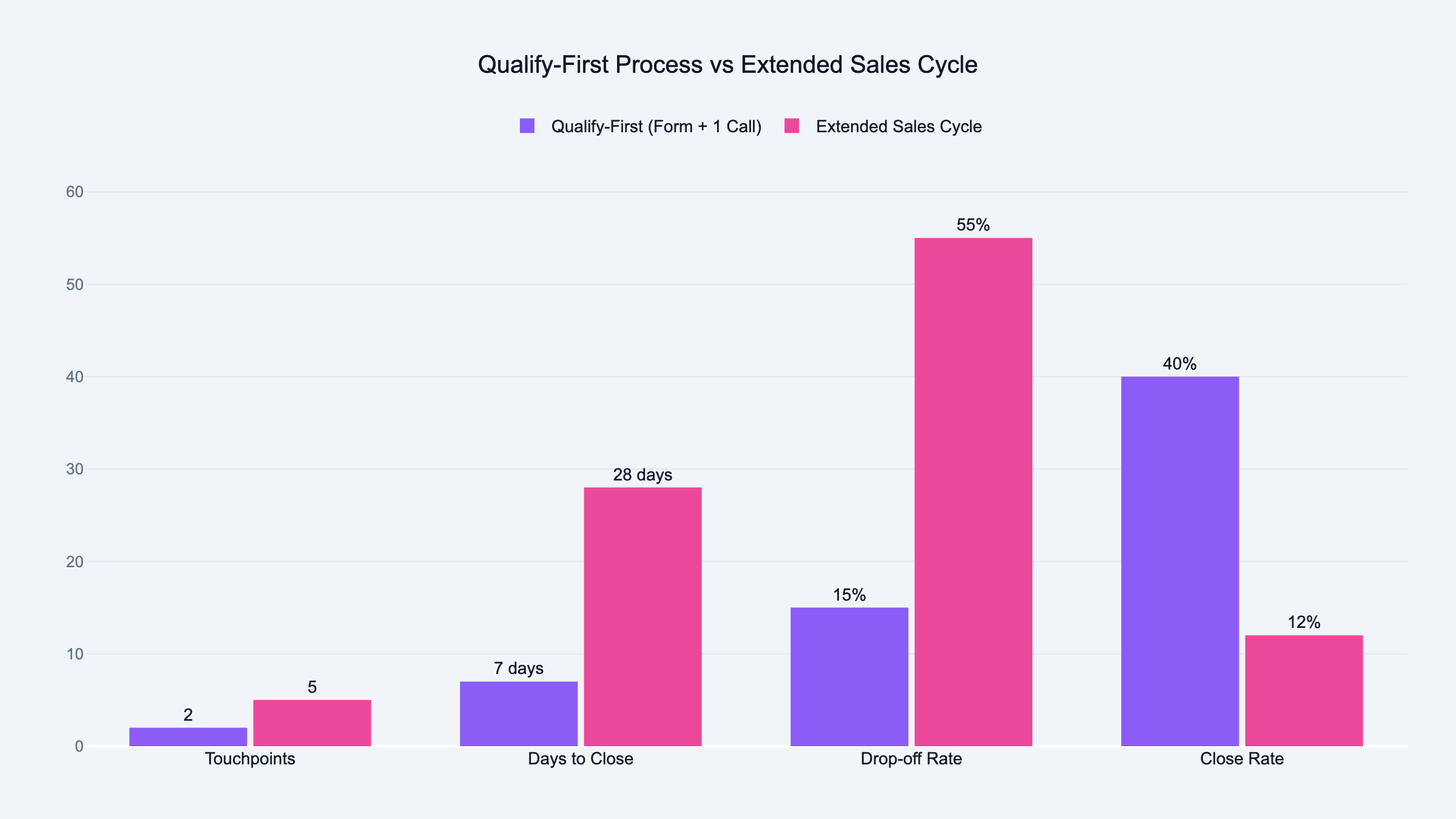
A good AI sales process is short and qualification-heavy. We use an AI-powered intake form to filter leads before anyone gets on a call. By the time I talk to a prospect, I already know their problem, budget, and expectations. The call becomes about solving, not qualifying.
After 20 years in business, the pattern is always the same. People overcomplicate sales. The same lesson I learned when getting my team to adopt AI: start with one thing, not five. They jump on a call with anyone who books, scope every detail, then send a proposal three weeks later.
Then they wonder why deals fell apart.
The simpler model: qualify first, then one call.
The qualifying happens before anyone gets on your calendar. An AI-powered intake form asks the right questions upfront. By the time someone books a call, you already know if they are worth talking to.
How Do You Qualify an AI Client Before the Call?
I qualify AI clients before the call using a four-question intake form. It asks what problem they want solved, their budget range, what tools they use, and what success looks like. Two red flags disqualify immediately: extreme skepticism about AI or expecting one agent to automate their entire business.
Not every lead deserves a call. Too many agencies chase leads that look perfect on paper.
The intake form does the filtering. It asks: What problem are you trying to solve? What is your budget range?
Then: What tools does your team use today? What does success look like for you?
Those four questions tell you almost everything.
There are two red flags that disqualify immediately.
The first is extreme skepticism. If they think AI is a gimmick, that project will be painful. Every deliverable will face resistance.
The second is the silver bullet seeker. One AI agent to automate their entire business. They saw a YouTube demo and think it works like that in production.
It does not.
The sweet spot is a client who believes AI can help and has a realistic view of what it takes. Every AI project needs client input, data access, and feedback loops.
On budget, the form handles it. "What would you expect this to cost?" filters out the people who want a custom suite for a thousand dollars.
By the time I get on the call, I already know their problem, their budget range, and their expectations. The call is not about qualifying. The call is about solving.
Why Should You Always Pitch the Long-Term Partnership First?
I pitch the long-term partnership first because it qualifies the client and sets the right frame. Clients shopping for cheap one-off builds reveal themselves immediately. Framing the first project as a starting point shifts their thinking from "buying one automation" to "testing a partnership." That is how we land retainers.
Pitch the retainer on call one. Not to close it, but to set the frame.
Tell every client: "We are only interested in long-term partnerships. We will do a paid project first to build trust. But our goal is to become your AI partner."
This does two things.
It qualifies the client. If they are shopping for the cheapest one-off build, they will tell you right away. Those clients haggle on price, expand scope without paying, and never come back.
It also sets the expectation that this first project is a starting point. The client stops thinking "I am buying one automation." They start thinking "I am testing a partnership."
That is how you land retainers. Consistent, reliable income. Not feast and famine.
How Do You Price AI Projects Without Guessing?
I price AI projects by estimating the hours, applying my hourly rate with a 30 to 40 percent margin, then adding 50 percent on top. That buffer is not greed. Every AI project takes longer than expected. API limits, messy client data, and sick days are real. Quote with buffer and deliver on time.
A lot of people online talk about value-based pricing for AI services. Charge based on ROI.
Sounds great in theory. In practice, it rarely works for custom projects.
The client has never seen the results yet. You are guessing how many hours their team will save. And what that time is worth.
It is guesswork dressed up as math.
The simpler model: estimate the time it takes. Put an hourly rate on it with a 30 to 40 percent margin.
Then add 50 percent on top of that.
That last part is not greed. It is reality. Every AI project takes longer than expected.
API limits pop up. The client's data is messier than they said. An engineer gets sick.
If you quoted tight, you eat the cost. If you quoted with buffer, you deliver on time.
Victor my co-founder says something similar. The biggest problem in any agency is not the work itself. It is finding good people to do it.
The same applies here. Time is the real cost, and time always expands.
What Is the Biggest Mistake When Delivering AI Projects?
Starting too big.
This is where most agencies fail. They scope three automations when the client only needs one to believe.
A 30-day timeline becomes 45 days. Credentials are late. Internal approvals get stuck.
Someone on the team goes on sick leave.
The lesson is obvious but almost nobody follows it: start with the smallest piece that still delivers value.
One automation. One clear win. Get it into production.
Let the client see results.
Then sell the next one.
The other mistake is presenting AI as a finished product.
Tell every client upfront: "The first two weeks after deployment are a testing phase. Things will break. We will fix everything."
This reframes expectations completely. Instead of losing trust when something breaks, you gain trust when you fix things quickly.
Chatbots hallucinate URLs in production. Validators flag everything as needing review. These problems are normal.
The difference is whether the client expects them or not.
What Does a Small First Win Actually Look Like?
Here is a real example of the right scope for a first project.
A client runs a marketing agency. Their account managers spend 90 minutes every Monday pulling campaign data from three platforms and pasting it into a Google Sheet for client reports.
The first AI project: automate that pull. One automation. One Google Sheet. One delivery every Monday morning before anyone starts their day.
That is it.
No dashboard. No chatbot. No full reporting suite.
The team gets 90 minutes back every Monday. The client sees the result on week one. I wrote a full walkthrough on automating client reporting with AI that covers exactly this kind of first project.
Now they trust you. Now you can sell the dashboard.
The temptation is to scope the full vision immediately. Build the intake form, the report automation, and the client-facing dashboard all at once.
The problem is that a 60-day project has 60 days of things that can go wrong. A 10-day project has 10.
Ben's rule applies here: one win as fast as possible. The client's confidence in the first 30 days determines whether you get months two through twelve.
Pick the automation that solves their most painful weekly task. Ship it. Then expand.
How Do You Keep Clients After the First Project?
Communication. That is the answer, and it is boring, but it is true.
The mistake most agencies make: engineers talking directly to clients on Slack. No project manager. No structured updates.
The result is chaotic messages, missed deadlines, and a client who feels like nobody is in charge.
Add a delivery manager. Weekly email updates. A scope of work document that clearly defines what is included and what is not.
The delivery manager frees engineers to focus on building. The client gets one point of contact instead of three.
When you are growing your AI service business, this layer becomes necessary. The moment you are juggling three projects, the chaos will cost you a client.
The scope of work document is the other piece. It lists what is covered and what is not.
Scope creep kills AI projects. A client will say "can you also add this small thing" six times. Without a clear scope document, you cannot push back.
What Actually Closes the Deal?
Numbers. Not your pitch deck. Not your proposal.
The client does not care about your process until they see what it produces. One clear result changes the entire conversation.
That is the real sales strategy. Get one win. Show it with real numbers.
Let the results do the selling.
Vinod my co-founder puts it simply: many people can build. Thousands of developers can write code and set up automations.
But the product goes nowhere without knowing how to sell it. The scarcest skill is not building the AI. It is getting someone to pay for it.
Pitch the pain, not the tech. Qualify fast. Start small.
Price with buffer. Deliver one win.
Let the numbers talk.
For a full guide on building the operational side of an AI agency — the systems, the tech stack, and the ops layer that protects your margin — see my breakdown of how to build an AI-powered marketing agency.
Frequently Asked Questions
How do I find my first AI agency client?
Start with businesses you already know. Look at companies in your network that have repetitive processes eating hours every week.
Content marketing works too. Agencies land clients through YouTube tutorials all the time. Unrelated demos attract business owners who see the potential.
How much should I charge for my first AI project?
Estimate the hours, add your hourly rate with a margin, then add 50 percent for unexpected delays. Keep the scope small enough that the total feels low-risk.
Most initial AI automation projects land between 2,000 and 10,000 dollars. The goal is not to cash in on project one. It is to land a long-term partnership.
How long does a typical AI automation project take?
A well-scoped single automation takes two to four weeks to build. Add another two weeks of testing in production.
Always quote 50 percent more time than you think. It is better to deliver early than to miss a deadline.
At minimum: an AI model like Claude or GPT, an automation platform like n8n or Make.com, and a project tracker. I compared the most useful ones in my guide on AI marketing automation tools.
The tools matter less than the process. A clear sales workflow and delivery system will beat fancy tech every time.
How do I handle scope creep on AI projects?
Write a scope of work document before starting. List what is included and what is excluded. When a client asks for something outside scope, offer it as a separate project.
This is not about being rigid. Uncontrolled scope changes are the number one reason AI projects go over budget.
What if the AI solution breaks in production?
It will happen. Every AI project hits issues in production that testing did not catch.
Chatbots hallucinate. APIs hit rate limits.
Frame the first two weeks as a testing phase. Tell the client upfront. Fix issues quickly.
This builds more trust than a perfect launch ever would.
Should I specialize in one type of AI service or offer everything?
Specialize. Pick one type of automation you can deliver consistently and build a repeatable process around it.
Once your first service is solid and generating referrals, add a second. Not before.
How do I pitch AI to a skeptical client?
Lead with their problem, not with AI. Do not open with "we build AI automations." Try "I noticed your team spends 30 hours a week on manual reporting."
Let them feel the pain first. Then introduce the solution.
What is the difference between a one-off AI project and a retainer?
A one-off project builds one solution and ends. A retainer makes you the client's ongoing AI partner, maintaining automations and building new ones.
Retainers create predictable revenue. Always pitch the partnership model from the first conversation.
How do I know if a client is ready for AI automation?
They have a clear, repetitive process that eats hours every week. Their software has API access. Expectations are realistic.
If they cannot describe their current process clearly, they are not ready. The best clients sit in the middle between skeptic and silver bullet seeker.