A demo beats a memo every time.
Give them permission to fail.
The first prompt won't be perfect. The first workflow will break.
That's fine. If people feel judged for not "getting AI" fast enough, they'll stop trying.
I've watched Vinod spend days figuring out a single data sync. He broke it, rebuilt it, broke it again.
That iteration is how you get to something that works. Your team needs the same space.
What Does a Realistic AI Adoption Timeline Look Like?
A realistic AI adoption timeline is three months. Month one: automate one task and show the team real time savings. Month two: add a second task while someone on the team becomes the unofficial AI champion. Month three: the old way feels slow and new hires wonder why it was ever done by hand. Most teams save 4 to 6 hours per week within 30 days.
Longer than the LinkedIn posts say. Shorter than you fear.
Month one:
One task automated. The team sees time saved. Skeptics are curious, not convinced.
Month two:
Second task added. The team starts suggesting use cases.
Someone on the team becomes the unofficial AI person. Let them.
Month three:
The old way of doing things feels slow. New hires ask why you ever did reporting by hand. The culture has shifted.
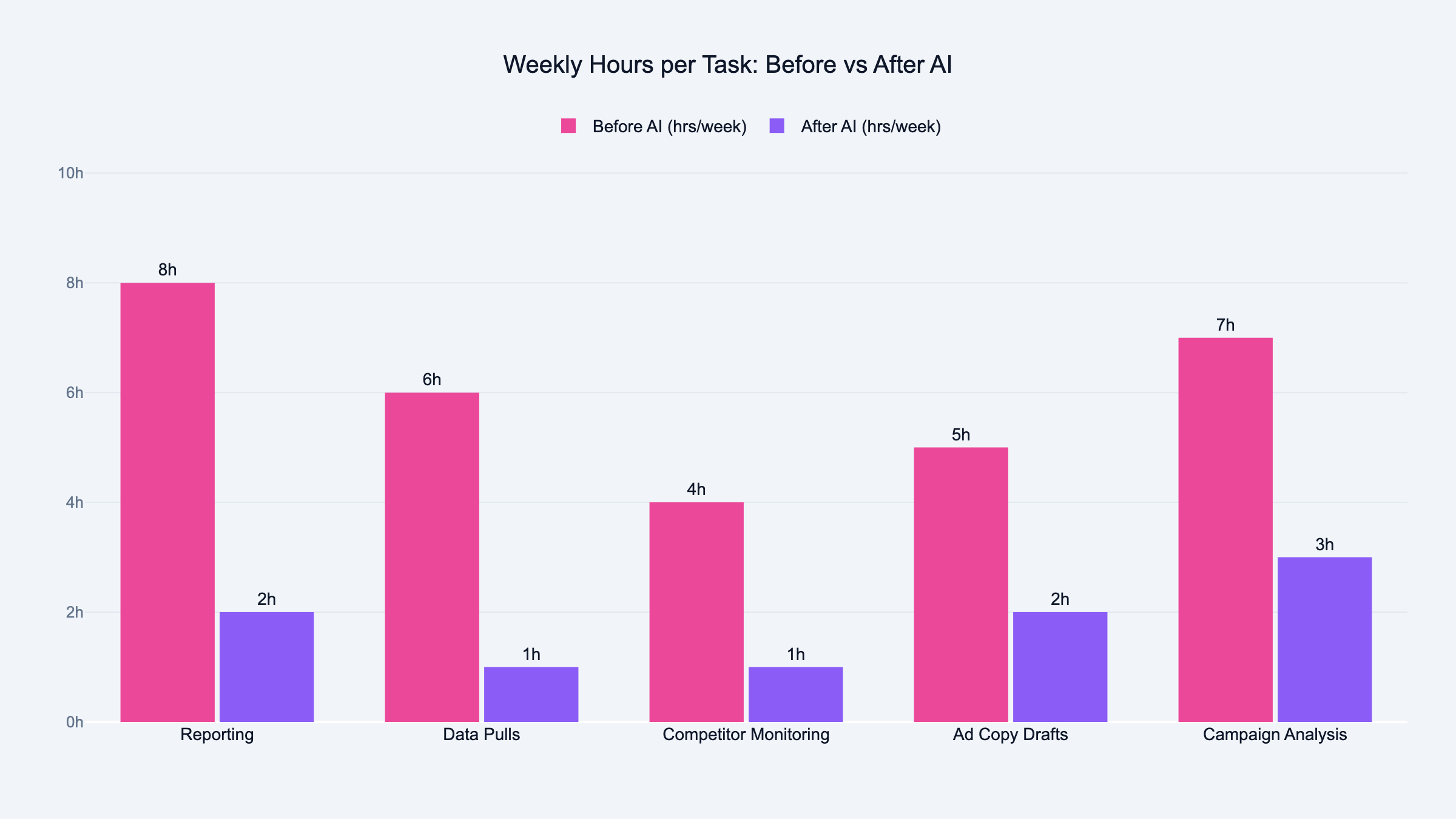
Most teams I've talked to report 4 to 6 hours saved per week within 30 days. The real payoff comes at month three when the team stops thinking of AI as a separate thing. It's just how the work gets done.
What Tools Should a Marketing Team Start With?
The ones that solve the task you picked in week one.
I'm not going to give you a list of 47 tools. That's part of the problem. Too many options paralyze teams.
Pick the task first. Then find the simplest tool that handles it.
If you are not sure where your team's skills need to develop to support this, I put together a breakdown of the AI skills every marketer needs in 2026.
For reporting and data pulls, we built Sucana. For ad copy, I use Claude. For workflow connections between tools, I've tested Make.com.
The tool doesn't matter as much as the process. A team that knows which task they're solving will find the right tool in a day. A team browsing AI tool lists will still be browsing next quarter.
The One Rule I Follow
Start small. Stay small. Let it grow.
Every successful AI adoption I've seen follows this pattern. The failures all tried to do everything at once. Once you find your rhythm, turn your processes into AI SOPs for your agency so any team member can run them.
I didn't wake up one day and replace my entire workflow with AI. I started with one data question, then another.
Eventually I let the AI analyze a full campaign. Each step built on the last.
Your marketing team is no different.
One task, one tool, one win. Then the next.
That's the strategy. It's not complicated. The hard part is resisting the urge to do it all at once.
Frequently Asked Questions
How long does it take for a marketing team to adopt AI?
Most teams see time savings within the first week if the use case is well-scoped. The culture shift takes about three months.
The real milestone is when nobody calls it "the AI tool" anymore. It's just how the work gets done.
What are the biggest barriers to AI adoption in marketing?
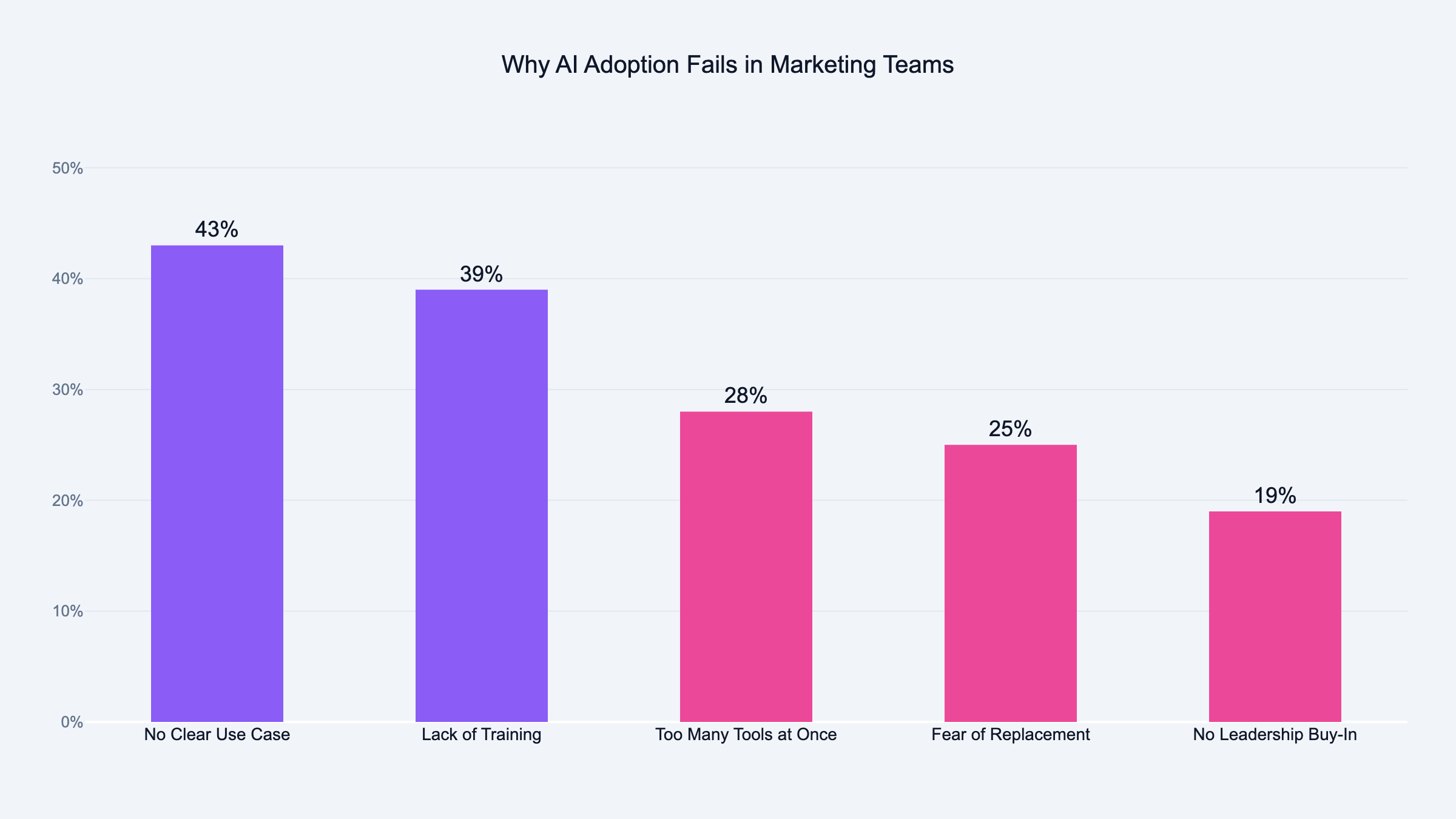
Lack of a clear use case is the top barrier. "Let's try AI" leads nowhere. But "let's fix this broken report" leads to real adoption.
Training and time investment rank second. People need space to learn without pressure.
Which AI tools should a marketing team start with?
The one that solves the task your team picked in week one.
For reporting, look at Sucana. For content, Claude or ChatGPT. For workflow connections, Make.com or n8n.
Don't browse tool lists. Pick the task, then find the tool.
How do you train a marketing team to use AI?
Start with one person. Let them learn the tool deeply. Then have them teach the rest of the team through real examples, not training slides.
Peer learning beats top-down training every time. People trust their colleague's demo more than a vendor webinar.
Will AI replace marketing jobs?
AI replaces tasks, not jobs. The tasks that disappear are the ones nobody wanted to do anyway.
Marketers who learn to use AI tools become more valuable. They do the same work in less time, or they do higher-level work that wasn't possible before.
What tasks should marketing teams automate with AI first?
Reporting, data pulls, competitor monitoring, and social media scheduling. These are high-frequency, low-creativity tasks that eat hours every week.
Stay away from strategy and creative direction as your first AI use case. Those require judgment that AI can't reliably provide yet.
How do you measure ROI on marketing AI tools?
Time saved per week is the simplest metric. Track how long the task took before AI and how long it takes now.
Most teams report 4 to 6 hours saved weekly. Multiply by your team's hourly rate. That's your monthly ROI.
What does an AI adoption roadmap look like for agencies?
First month: automate one repeatable task for the whole team. Second month: add another task and identify your internal AI champion.
By month three, the team suggests new use cases on their own.
The roadmap is simple because simplicity is what makes it work. Complex rollout plans stall at month one.
How do you handle team resistance to AI tools?
Let the team pick the first use case. Show them the tool working on their own data. Give them permission to fail.
Resistance drops when people feel ownership over the process. Mandates from leadership create the opposite effect.
What is the difference between marketing automation and AI?
Marketing automation follows rules you set. Send this email when someone clicks this link. It does exactly what you tell it.
AI learns from data and makes decisions. It reads your campaign numbers and spots patterns you missed.
Automation executes. AI thinks.
How do you get buy-in from leadership for AI tools?
Run a small pilot first. Measure the time saved. Show leadership the numbers from one real task, not a pitch deck about AI potential.
Real results from a real task beat projections every time.
What mistakes do marketing teams make when adopting AI?
The biggest mistake: trying to automate everything on day one. Five tools, ten use cases, total chaos.
The second biggest: picking the tool before identifying the problem. Start with the pain, not the product.