
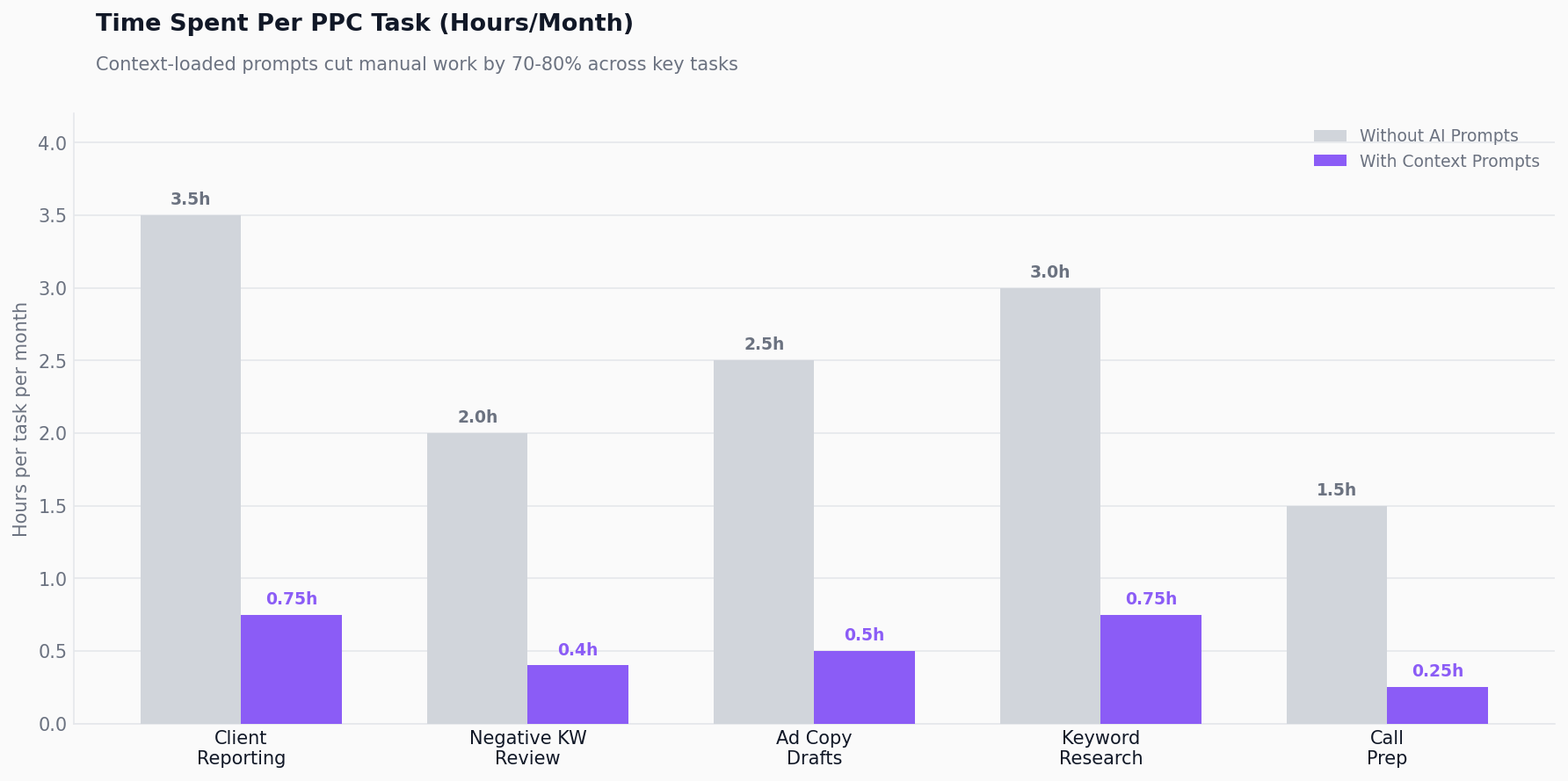
Prompt 8 alone saves most account managers 2 to 3 hours per client per month. If you want to automate the full reporting workflow, I wrote a guide on how to automate client reporting with AI.
You still review every word before it goes out.
But the first draft, which used to take 45 minutes of staring at a blank page, takes 2 minutes now.
Troubleshooting Prompts
How do you use ChatGPT to troubleshoot PPC campaigns?
Prompt 10: Learning phase reset
My Google Ads campaign hit the learning phase again after [what you changed].

Campaign type: [type]
Current budget: $X
Current daily spend: $X

What are the most likely causes?

What should I do, and what should I avoid, for the next 7 days to get through the learning phase faster?
Prompt 11: CTR drop investigation
My CTR dropped from [X%] to [X%] between [month A] and [month B].

Variables that changed during this period: [list them]

What are the most likely causes?

Rank them from most likely to least likely.

For each: what specific data would confirm or rule it out?
The troubleshooting prompts work because you're asking ChatGPT to think with you, not for you.
You give it the variables.
It gives you a ranked hypothesis list.
You verify each one against your actual data.
It turns a 2-hour debugging session into a 20-minute one.
Strategy Prompts
Prompt 12: Scaling roadmap
Act as a PPC strategist.

[Paste context layer]

My client wants to scale from $X to $X monthly spend in 90 days.

Current ROAS: X
Target ROAS: X

Give me 3 scaling approaches.

Rank them by risk level: low, medium, high.

For each: what has to be true for it to work, and what could go wrong.
Prompt 13: Landing page structure
Act as a conversion copywriter who specializes in paid traffic landing pages.

Offer: [description]
Target audience: [description]
Their biggest objection: [the thing that stops them from converting]
Traffic source: [Google / Meta / LinkedIn]

Write a landing page structure.

Include: hero copy, 3 benefit statements, trust signals, CTA copy.

Every line should address the specific audience and offer.

No generic copywriting.
The One Prompt That Saves the Most Time
Of everything in this list, one prompt I use more than any other.
It's not clever.
It's not long.
But it changes how ChatGPT works for the entire session.
You're a senior PPC account manager at an agency.

Full account brief:

[Paste context layer]

I'm going to ask you questions. Answer from this context only.

If you don't have enough information to answer, tell me what I need to give you.

Don't invent data or make assumptions.
You set this up once at the start of a new conversation.
Then you ask anything.
Campaign health check.
Ad copy review.
Client prep.
Reporting draft.
ChatGPT becomes a co-pilot that knows your client.
Not a search engine that gives Wikipedia answers.
That is the difference between PPC managers who are getting real value from AI right now and the ones still frustrated by it. For a broader look at where all of this is heading, see my take on the future of PPC with AI.
What These Prompts Will Not Do
They will not give you real search volume data. For that, use tools like Google Keyword Planner.
They will not pull live metrics from your ad accounts.
They do not know what happened in your campaigns last week unless you paste that data in.
ChatGPT is a thinking partner, not a data source.
Give it real data.
Ask specific questions.
Review every output before it goes anywhere.
For actual campaign data, including spend, ROAS, CPL by channel, and performance by audience, you need a proper analytics layer connected to your ad platforms. I cover how to set that up in my guide on automating Google Ads reporting with AI.
The prompts cover the thinking, writing, and preparation work.
The data work needs real tools.
Frequently Asked Questions
What are the best ChatGPT prompts for PPC managers?
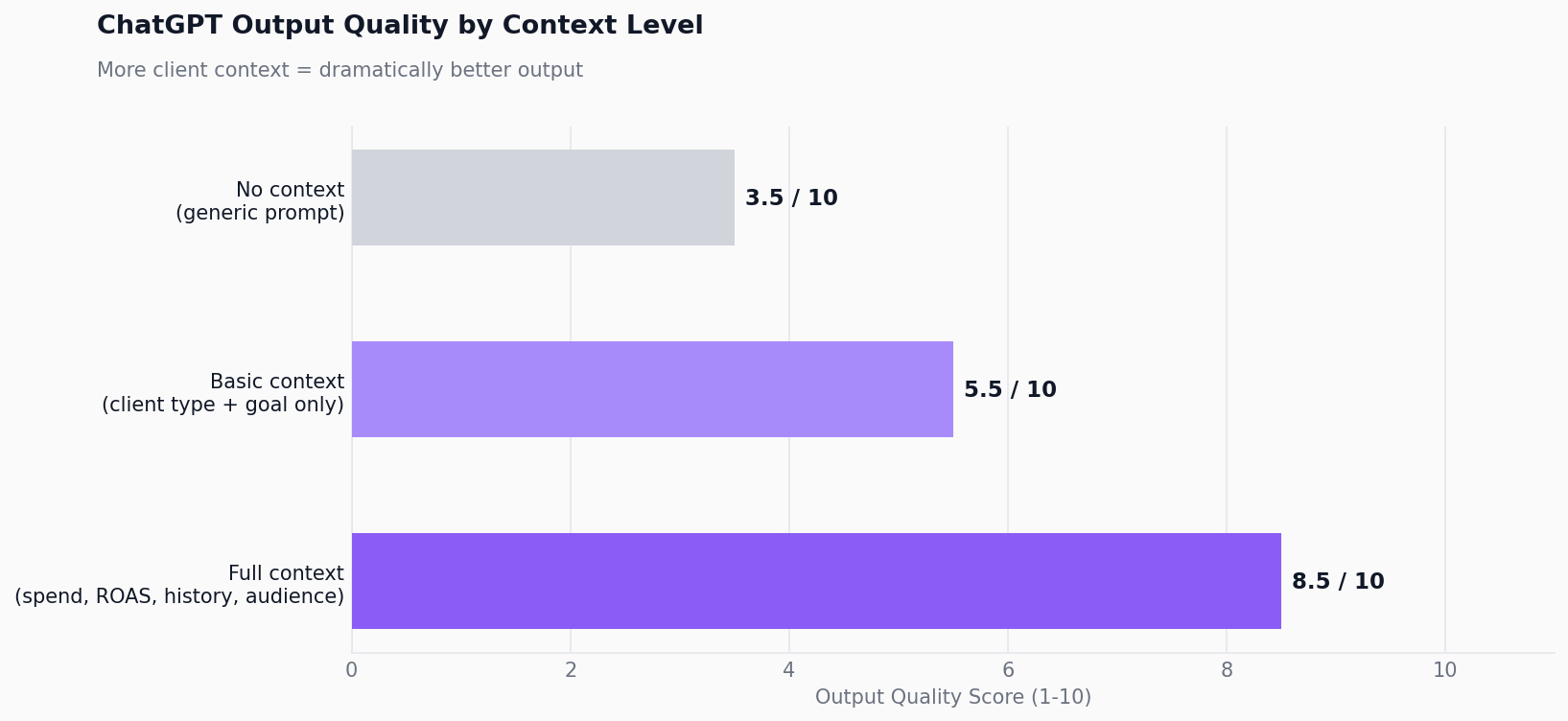
The best prompts are the ones that include your client's actual context before you ask anything.
Feed ChatGPT the spend, goals, ROAS, and account history at the start of every session.
Generic prompts produce generic answers.
The prompts in this article are structured so the context goes in first.
Why do most ChatGPT PPC prompts give generic output?
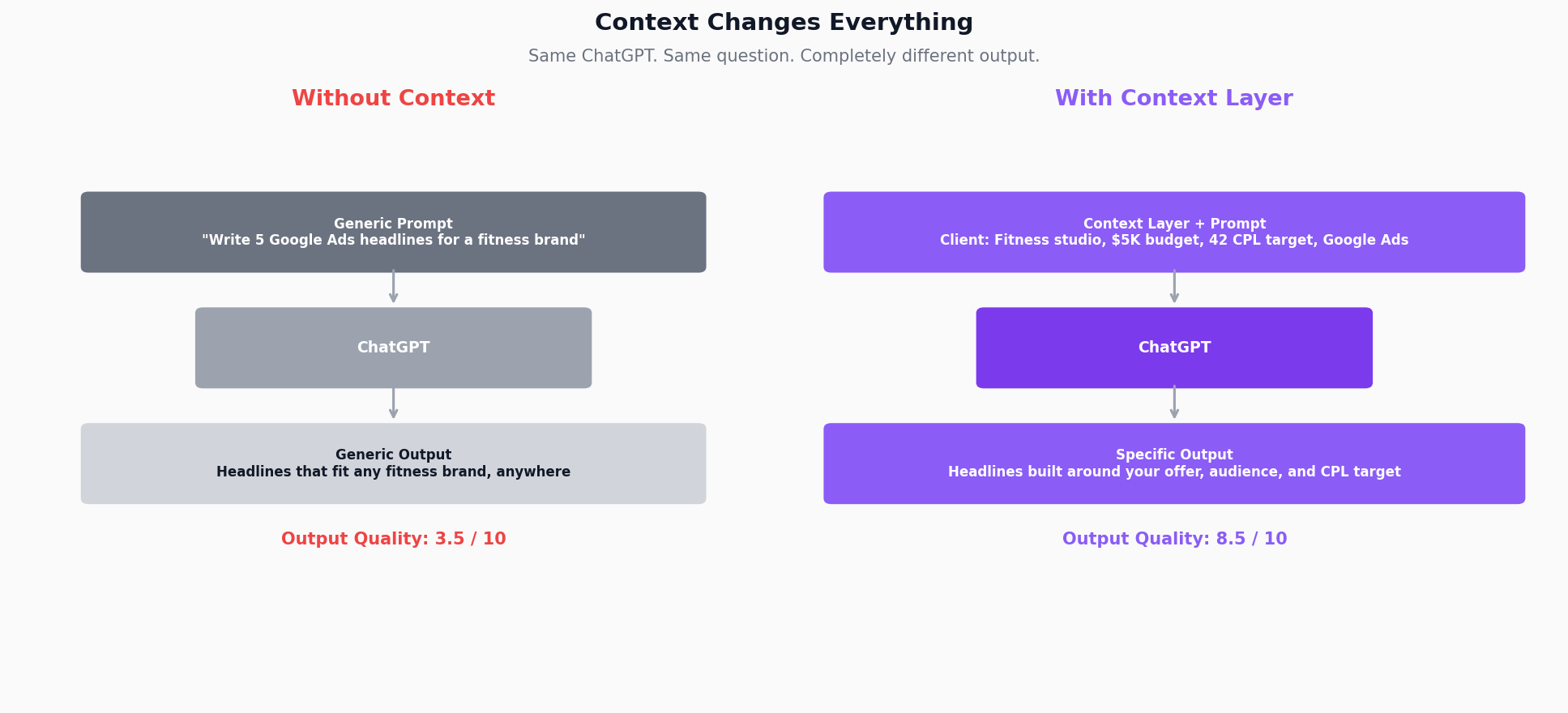
Because they give ChatGPT no information to work with.
Ask "write Google Ads headlines for a fitness brand" and ChatGPT writes for a fictional average client.
It has no idea what your actual offer is, who your audience is, what has worked, or what the CPA target is.
The more context you give, the more specific and useful the output.
Can ChatGPT replace a PPC manager?
No.
It speeds up specific tasks: ad copy, keyword grouping, negative keyword review, report writing, client prep.
But it cannot see your campaign data in real time.
It cannot make judgment calls about budget or strategy without human context.
The PPC manager still needs to provide the data, review the output, and make the final decisions.
What is the best way to use ChatGPT for Google Ads?
Start every session by pasting in your client context: budget, platform, goal, ROAS, what's working, what isn't.
Then ask specific questions about that account.
The more specific the context, the more specific the output.
How do I use ChatGPT for ad copy?
Paste in your best-performing existing headlines or ad copy as reference material.
Then ask ChatGPT to write variations that test a specific angle while following the same structure.
Always give it a character limit and specify the exact format you need.
Can ChatGPT do keyword research for PPC?
It can generate long-tail keyword ideas, group keywords by intent, and flag likely negative keywords from a search term report.
It cannot give you real search volume data.
Validate any keyword list against real data in Google Keyword Planner, Semrush, or similar tools before adding anything to a live campaign.
How do I use ChatGPT for PPC client reports?
Paste in your key metrics for the reporting period and a brief client context note.
Ask it to write a plain English summary at a specified length.
Specify that the audience is not a PPC expert.
Always review the draft before it goes to the client.
What ChatGPT prompt works best for negative keywords?
Paste your top search terms by impressions from the past 30 days.
Ask ChatGPT to identify which terms show a clear mismatch with your campaign goal.
Ask it to rank them by priority and explain its reasoning for each flag.
Run a final review yourself before adding anything to the live account.
How do I use ChatGPT to prep for a client call?
Tell ChatGPT what conclusion you're planning to give the client and paste in your supporting data.
Ask it to give you 3 ways the client might challenge that conclusion, and how to respond to each.
It turns 20 minutes of nervous prep into a fast structured rehearsal.
How often should I use these ChatGPT prompts in my workflow?
For account managers running multiple clients, the highest-value tasks to run through ChatGPT are monthly reporting drafts, negative keyword reviews, and ad copy variation testing.
Run the client prep prompt before any performance review call.
The goal is not to use AI for everything.
The goal is to use it for the tasks where the first draft costs you the most time.