What Does the Future of PPC Look Like with AI?
The future of PPC is AI doing the execution while agencies own the strategy and data. Bidding, targeting, and reporting are already automated. The agencies winning in 2026 are the ones feeding AI clean first-party data from their CRMs. Victor runs his entire client portfolio this way now. Control shifted from buttons to inputs.
The agencies that win are not the ones fighting AI. They are the ones feeding it better data than everyone else. I wrote a full breakdown of how AI is reshaping performance marketing across every major ad platform.
I know because I am building the tools that sit between the agency and the platform. The game changed. The role changed.
The agencies that figure this out first will eat the rest.
Victor my co-founder runs an ad agency. One of his clients asked him a question that stuck with me. "Why don't I just hire someone in-house instead of paying your rates?"
Victor's answer was instant. "The biggest, biggest problem is finding good media buyers. Nearly impossible."
That was six months ago. Today the answer is different.
The scarcity is real. But the fix is no longer just "hire better."
AI now handles what media buyers used to spend all day on. Bidding. Reporting.
Search term analysis. Audience signals.
The agencies that understood this early are pulling ahead. The ones still doing it the old way are falling behind fast.
How Is AI Changing Google Ads Right Now?
Google replaced manual campaign controls with AI-first formats like Performance Max, AI Max, and Demand Gen. The platform now picks audiences, writes ad copy, and chooses placements automatically. Agencies lost the levers they used to pull by hand. The new job is feeding the system better data and stronger creative than competitors do.
Google pushed Performance Max, AI Max, and Demand Gen as default campaign types. That is not a suggestion. That is the direction.
Campaign types are collapsing into AI-first formats. Fine-tuned controls are disappearing. The platform picks your audience, writes your ad copy, and chooses your placements.
For agencies used to pulling every lever by hand, this feels like losing the wheel.
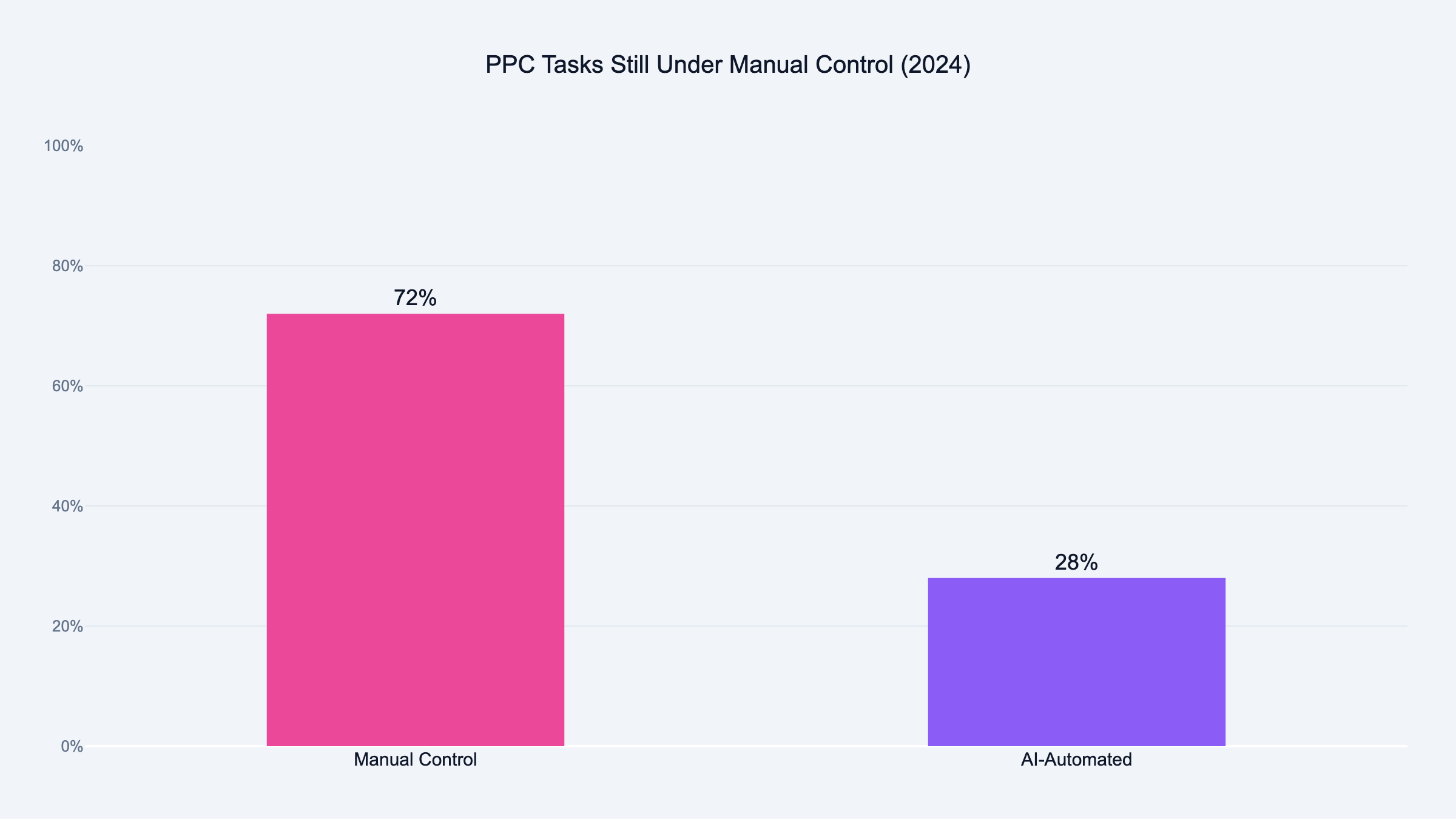
I talked to Victor about this last month. He said something that clicked.
"I used to spend two hours a day on bid adjustments. Now the platform does it. But I spend those two hours reading the data and deciding what to feed it next."
That is the shift. The hands moved from the keyboard to the strategy.
Why Do PPC Managers Feel Like They Are Losing Control?
PPC managers feel like they are losing control because Google keeps removing manual levers and hiding data. Performance Max shows limited search term reports. Campaign transparency dropped. Victor told me he can no longer explain Tuesday's cost per lead spike to clients because the platform won't show what changed. Trust in Google's AI dropped 54% in net sentiment last year.
Trust in Google declined 54% in net sentiment last year. That is not a small number.
More than half the industry is saying: I trust you less than I did twelve months ago.
The frustration is real. Performance Max campaigns show limited data. You can't see search terms the way you used to.
Explaining to a client why their cost per lead dropped on Tuesday? Good luck with that.
One B2B advertiser ran a Performance Max campaign that chased weekend bot signups. The system did exactly what it was told, just with garbage signals.
This is the tension every agency owner feels right now. Google says "trust the AI." Agencies say "show me the data first."
What Is the Real Job of a PPC Agency in 2026?
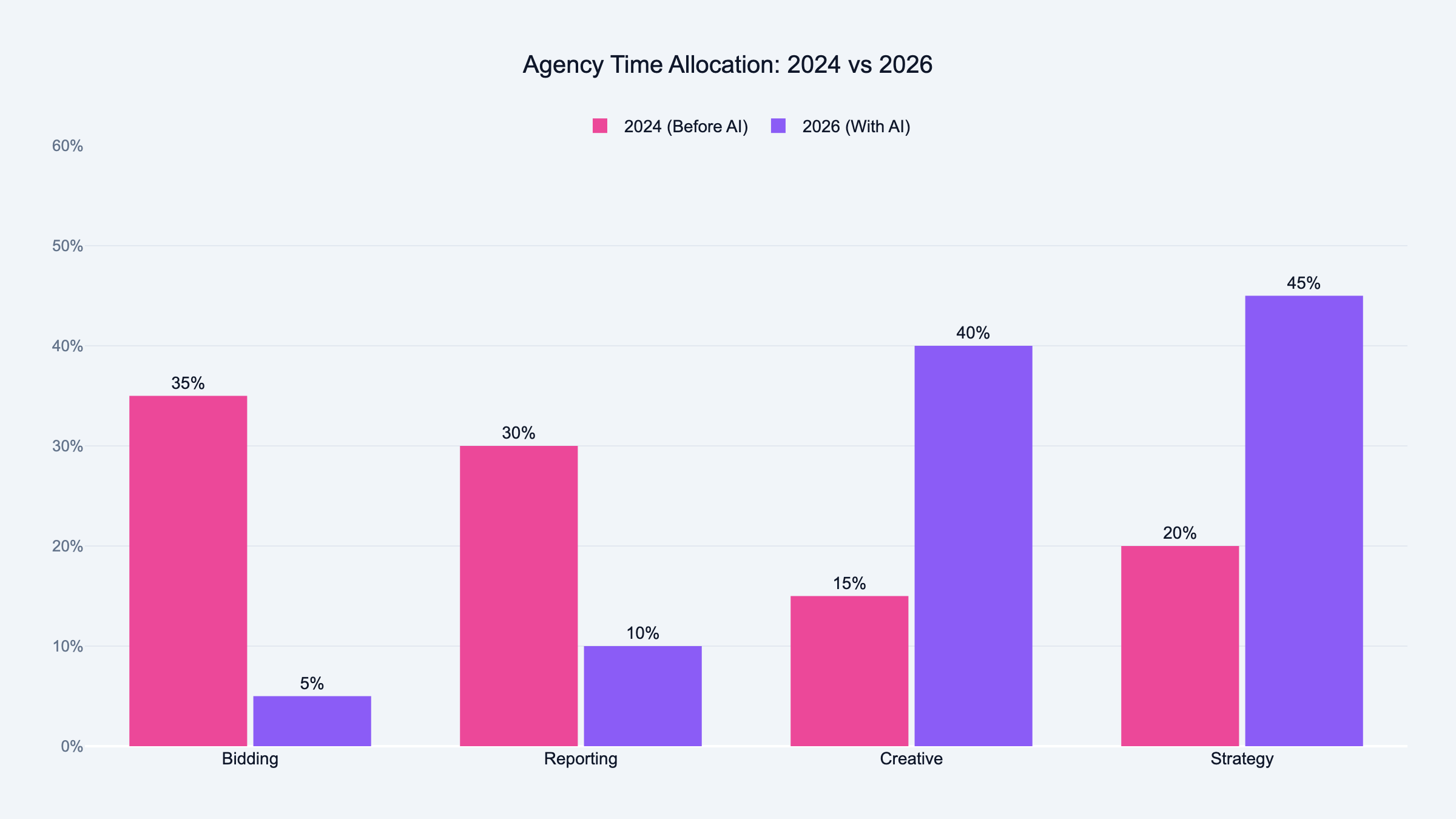
The real job of a PPC agency in 2026 is three things: data quality, creative strategy, and client translation. Bidding and targeting are automated. What remains is feeding the AI clean CRM data, testing more creative variations than competitors, and explaining results in language clients understand. We built Sucana around exactly this shift.
The job is no longer clicking buttons inside the ad platform. The job is three things.
Data quality.
The AI is only as good as what you feed it. Clean conversion tracking, proper first-party data, CRM signals that tell the platform which leads turned into revenue.
Not just which ones filled out a form.
Creative strategy.
When bidding and targeting are automated, the only lever left is what the ad looks like. Agencies that invest in creative testing and hook variations will beat the ones still tweaking audiences by hand.
Client translation.
Someone has to sit between the AI and the client. That person explains why the numbers look the way they do.
A dashboard can't do that. It takes someone who understands both the platform and the business.
I see this every day with Sucana. We are building the data layer that connects ad platforms to real business outcomes.
The agencies using it spend less time in spreadsheets and more time talking to clients. That is the future.
How Do Agencies Stay Relevant When AI Does the Bidding?
Agencies stay relevant by owning the data layer between the ad platform and the client's business. Connect your CRM so revenue data flows back into Google and Meta. Invest in creative testing. Translate AI output into language clients actually understand. The agencies doing all three are growing. Victor connected his clients' CRMs and cut reporting time by 80%.
I told Victor this last month. The agencies that survive are not the ones who learn AI the fastest. They are the ones who learn to ask the right questions.
"Show me which campaigns drove revenue, not just leads." AI can't ask that for you. It can answer it, if your data is clean. But the question comes from knowing the client's business.
Google's AI can run a campaign and get you leads at $12 each. But if those leads never close, you just burned the budget on empty numbers. The agency's job is knowing the difference.
First-party data is the fuel. Every agency I talk to that is growing right now has one thing in common. They connected their CRM to their ad platform.
Real revenue data flows back into the system. The AI gets smarter because the inputs are real.
The ones struggling? Still reporting on cost per click and impressions. Those numbers mean less every quarter.
Will AI Replace PPC Managers?
No. But it will replace the ones who only know how to press buttons.
The PPC manager of 2026 is not an ad platform operator. They are a strategist who happens to use ad platforms.
Victor has ten clients. He used to spend 60% of his time inside Facebook and Google doing manual work. Now he spends that time on creative direction and client calls.
His results did not get worse. They got better. He stopped fighting the machine and started feeding it.
The role evolved from execution to oversight. From "I set the bid" to "I set the strategy and the AI executes."
The managers who made that shift are more valuable than ever. The ones who refused are looking for new jobs.
What Should Agencies Do Right Now?
I will keep this simple. No wall of theory. Just what to do on Monday morning.
Connect your CRM to your ad platforms. If your leads and revenue data are not flowing back into Google and Meta, the AI is flying blind. Start there.
Test more creatives. When the platform controls targeting and bidding, the creative is your biggest variable. I wrote a full workflow for writing Google Ads copy with AI that covers how to use Claude to generate and test headlines at scale.
Run more hooks, test more angles. Victor generates hundreds of variations per campaign.
Stop chasing vanity metrics. Cost per click is dead as a primary KPI.
Qualified leads are what matter. If your reporting doesn't show that, fix the reporting first.
Build a data layer. This is what we are doing at Sucana. An AI layer on top of your ad data that connects to your CRM.
It tells you what is actually working. Not what the platform says. What your bank account says.
Learn to question AI output. Performance Max gives you a number. Your job is to ask why.
If the AI says ROAS is 4x but the pipeline is empty, something is broken in the data chain. Find it.
Here is what Victor's setup looks like now, which is a real example of each of these in practice.
He connected his clients' CRMs to Meta and Google. Every closed deal fires a conversion event back into the platform. The AI now trains on revenue, not just form fills.
His reporting moved from spreadsheets to a live dashboard connected to all four platforms.
He cut his Monday morning reporting from two hours per client to 20 minutes for all clients combined.
That freed up four to five hours every week. He uses that time on creative strategy and client calls.
The tools are available to every agency right now. What takes time is the setup and the discipline to keep the data clean.
One week of CRM cleanup and proper conversion tracking. That is the investment. The payback is faster than most agencies expect.
What Happens to Agencies That Ignore This?
They shrink. Slowly at first, then fast.
I watch this happen in real time. Agencies that still build manual campaigns and export CSVs by hand are losing clients to shops half their size.
The smaller agencies move faster. AI made team size less important than data quality. The numbers on AI replacing marketers show the same pattern across the industry.
Google dropped the Customer Match threshold from 1,000 to 100 users. Small agencies can now use audience targeting that was locked behind scale.
The playing field flattened. If you are thinking about building an AI-powered marketing agency, this is the window.
The agencies with five people and clean data will beat the agencies with fifty people and messy spreadsheets. That is not a prediction. It is already happening.
Frequently Asked Questions
Will AI replace PPC managers?
AI will replace the tasks, not the people. Bidding, basic reporting, and audience selection are already automated.
The PPC managers who shifted to strategy, creative direction, and client communication are more in demand than ever. The ones who only knew the buttons are at risk.
How is AI changing Google Ads in 2026?
Google consolidated campaign types into AI-first formats like Performance Max and AI Max. The platform now handles bidding, targeting, and ad copy.
Agencies have less manual control but more signal-based influence. The shift is from pulling levers to feeding the machine better inputs.
What is AI Max in Google Ads?
AI Max automates targeting, bidding, and creative across all of Google's surfaces. It looks at entire conversations and browsing patterns, not just keywords.
For agencies, the old keyword-based targeting model is fading. Context and signals matter more than match types.
Should agencies trust Google's AI automation?
Trust but verify. Google's AI follows whatever signals you give it. Clean tracking and accurate conversion goals produce strong results.
Messy data produces messy output. One bad conversion goal can train the system to chase garbage leads at scale.
How do PPC agencies stay relevant with AI?
Own the data layer between the platform and the client's business. Invest heavily in creative testing. Translate AI output into language clients understand.
The agencies that do all three are growing. The ones doing none of them are shrinking. I wrote a full guide on how Claude reads campaign data that shows what this looks like in practice.
What skills do PPC managers need in 2026?
Data literacy comes first. Read what the AI is doing and know when it is wrong. Mastering AI prompt engineering for PPC is now a core part of that skill set.
Creative direction is second. When bidding is automated, the ad is the only variable left.
Client communication rounds it out. Explain AI-driven results to business owners who just want to know if the phone is ringing.
For most advertisers, yes. Performance Max reaches all Google surfaces and adjusts in real time. Manual campaigns give more control but demand more time.
The sweet spot for agencies: use Performance Max as the engine. Layer on clean data, strong creatives, and negative keyword lists as guardrails.
How do agencies explain AI-driven results to clients?
Start with business outcomes, not platform metrics. "Your cost per qualified lead dropped 18%." That lands better than "your impression share went up."
Connect every number to something the client cares about. Revenue, pipeline, booked calls.
The AI gives data. Your job is to give the client a story.
What first-party data do agencies need for AI ads?
Lead status from your CRM, revenue per lead, and which leads actually closed. Feed that back into the ad platform so the AI knows which conversions matter.
Most agencies only send form fills. That trains the AI to find more form fillers, not more buyers.
How do you keep control of Google Ads with AI automation?
Control shifted from manual settings to strategic inputs. You set the conversion goals, audience signals, creative assets, and negative keyword lists.
Set tight guardrails. Review search term reports weekly and kill bad placements fast. The AI runs inside the box you build.