
He wants one view. All clients. Color-coded by severity.
Click a warning, land in the client's data.
That is the agency dashboard we are building at Sucana.
How Victor Uses Claude to Run This Check in 30 Seconds
Victor does not do all of this manually anymore. He built a Claude skill that holds his entire diagnostic chain. The metric hierarchy, the funnel logic, the warning thresholds, all of it lives inside one prompt. I took this a step further and built a full agency brain on Claude Code that houses every skill in one place.
Here is how he does it, step by step.
Step 1: Build a Claude skill with your diagnostic logic.
Open Claude and create a project. In the project instructions, paste your version of Victor's chain:
"When I upload campaign data, check spend, leads, and CPL first. Compare this week to last week.
If CPL increased more than 20%, check CPM, CTR, and CPC.
If CPM and CTR are stable but CPL went up, the problem is on the landing page.
If CTR dropped, the problem is the creative.
If CPM spiked, the problem is auction competition.
Always tell me where the problem is and what to fix first."
That skill now lives in your Claude project. Every time you come back, it remembers how to read your data. For more on writing effective instructions, see my AI prompt engineering guide for PPC.
Step 2: Export your campaign data as a CSV.
Go to Ads Manager. Select your campaigns. Export the last 30 days as a CSV file. Include spend, impressions, clicks, leads, and CPL at the campaign level.
Step 3: Upload the CSV and ask Claude.
Drop the CSV into your Claude project. Ask: "Run the diagnostic chain on this data. Which campaigns need attention?"
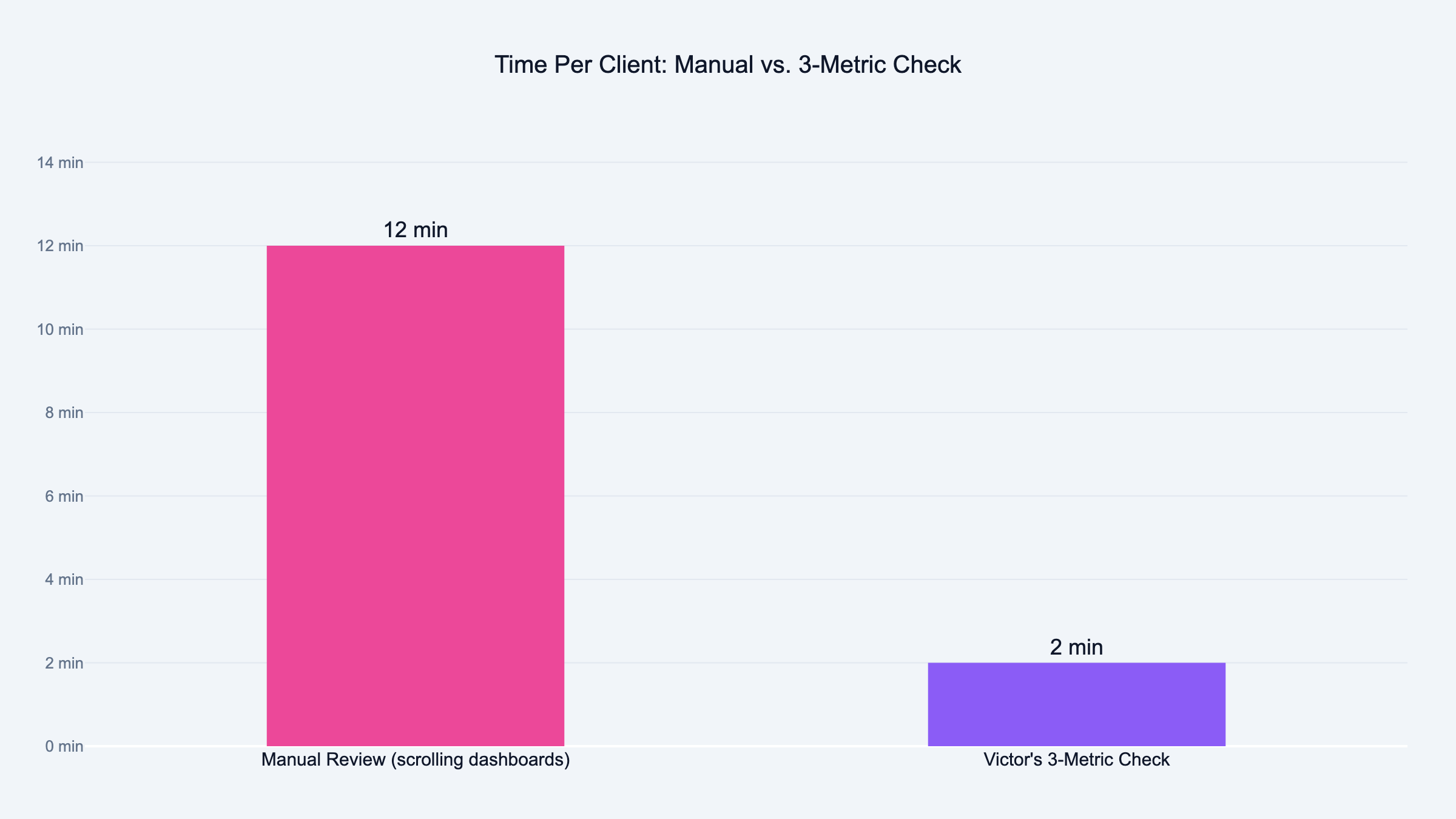
Claude reads the file, runs the chain, and comes back with exactly what Victor would say. Except it takes 30 seconds per client instead of 12 minutes.
Victor missed a landing page conversion drop for two weeks. This check would have caught it on day one.
Step 4 (optional): Use Sucana instead.
This same approach works for Google campaigns too. I covered automating Google Ads reporting with AI in a separate guide. If you do not want to build this yourself, that is what Sucana does. We connect to your ad accounts directly. No CSV exports. No manual uploads. The diagnostic chain runs automatically every day across all your clients.
You open the dashboard. Warnings are already there. Click one, see the data, ask the AI what happened.
That is the difference between a Claude skill you built yourself and a product built for agencies. Both work. One saves you the setup.
Frequently Asked Questions
What metrics should a media buyer check every day?
Start with three: spend, leads (or purchases), and cost per lead (or cost per purchase). These tell you if the campaign is on track. If all three are stable, move to the next client.
Only dig into secondary metrics like CPM, CTR, and CPC when cost per lead spikes. Checking everything every day wastes time without improving decisions.
How do I know if my CPL is too high?
Compare it to your own baseline, not industry averages. If your CPL was $15 for three weeks and jumps to $30, that is a problem. The absolute number matters less than the trend.
Industry averages vary wildly. The median CPL across 7,000+ agencies is $50.51. Your niche, offer, and funnel will set your real target. I wrote a full Facebook Ads CPL troubleshooting checklist for when things go sideways.
What causes CPL to spike overnight?
Four common causes: landing page broke or changed, ad creative is tired and CTR dropped, CPM increased from more auction competition, or an ad got rejected and spend shifted to worse ads.
Run Victor's diagnostic chain. Check CPM, CTR, and CPC. The combination tells you where the problem lives.
How is analyzing e-commerce campaigns different from lead gen?
E-commerce needs six metrics instead of three. Spend, ROAS, sales amount, number of orders, cost per purchase, and cost per acquisition. Different e-commerce owners prioritize different numbers depending on their product and margins.
Lead gen is simpler because the output is one thing: a lead. E-commerce has revenue, order count, and order value as separate signals that all matter.
How often should I check campaign data?
Daily for active campaigns. Victor checks every client's three primary metrics every morning. The full check takes under two minutes per client.
Weekly deep dives catch trends that daily checks miss. Compare this week's CPL to the four-week average. Flag any campaign where CPL increased more than 20%.
What is the difference between CPL and CPA?
CPL is cost per lead, what it costs to get someone to raise their hand. CPA is cost per acquisition, what it costs to get an actual customer or sale.
A low CPL with a high CPA means your leads are cheap but not converting. This is the trap Victor flagged with Latin America, cheap leads that never close.
How do I know if the problem is my ad or my landing page?
Run Victor's diagnostic chain. If CPM, CTR, and CPC all look normal but CPL went up, the problem is on the landing page.
The ad is doing its job. People are clicking. They are just not converting after they land.
If CTR dropped, the problem is the ad. If CPM spiked, the problem is auction competition.
What should an agency dashboard show at the top level?
A table of all clients with their primary metrics and color-coded warnings. Red for critical issues, orange for things that need attention. Victor wants to see which clients need action without clicking into each one.
The flow is: see the warning, click into it, land in the client data, investigate. Not the other way around.
How do I tell if creative fatigue is the problem?
Watch frequency and CTR together. If frequency is climbing and CTR is dropping, the same people are seeing the same ad too many times. They stopped clicking because they have seen it before.
Refresh the creative. Do not adjust the budget or targeting. The audience is fine.
The ad is tired.
Can AI replace a media buyer's daily analysis?
AI can run the diagnostic chain faster than any human. It catches patterns in seconds that take hours manually. Victor my co-founder watched our AI describe his exact strategy from the numbers alone.
But AI cannot decide what to do next. I covered the full picture in my guide on AI for Facebook Ads. Victor caught a Latin America scaling trap because he knows cheap leads do not always close.
That judgment comes from experience, not data processing. The answer is both: AI for speed, human for judgment.