
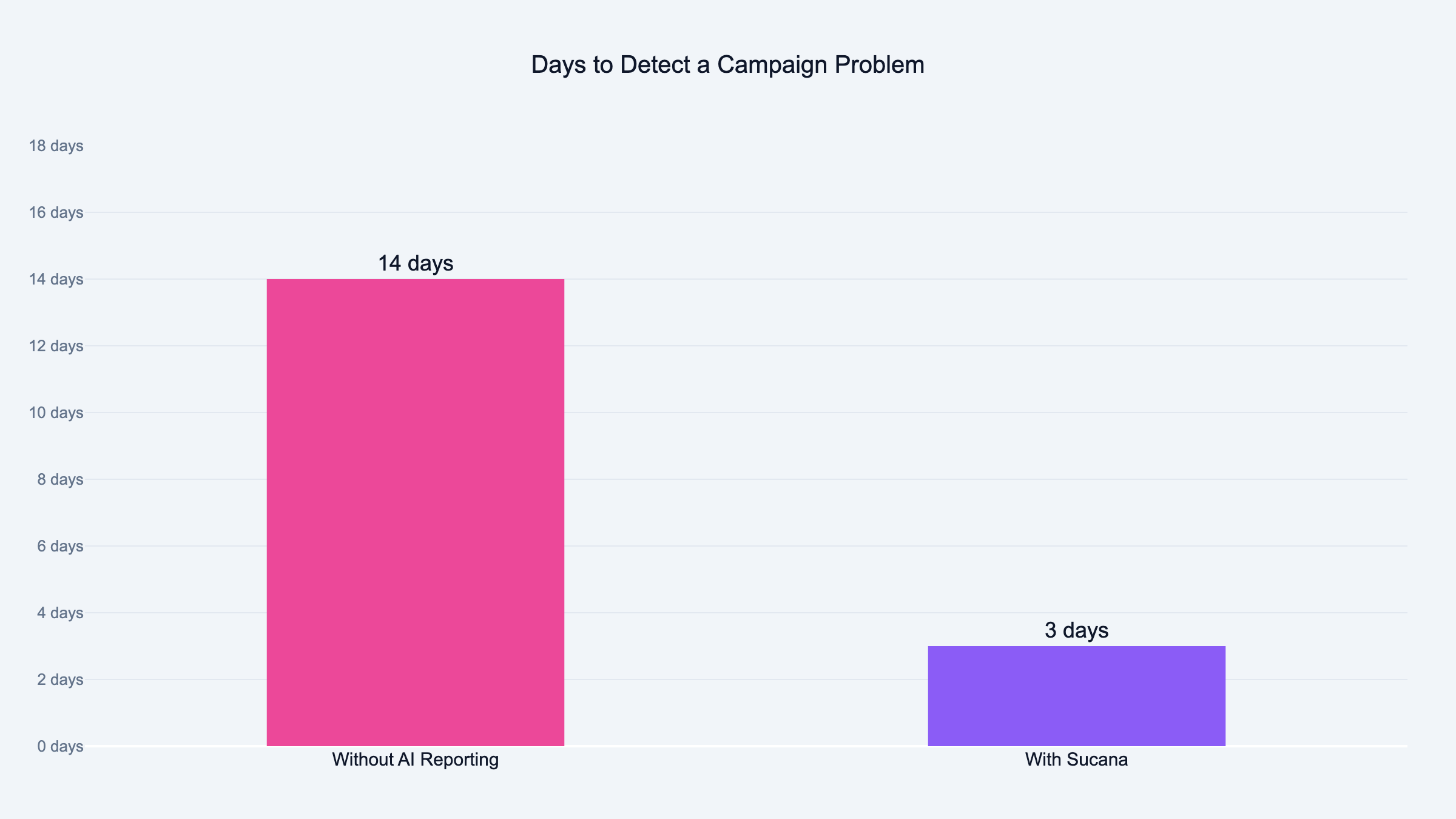
AI helps you find it faster. The recommendation proves you are still doing the job. Once you can do this consistently, pitching AI services to clients becomes straightforward.
Step 8: Answer the AI Question Before They Ask It
Most clients who question AI have one real fear: that you are doing less work for the same fee.
Address it in the report, before they bring it up.
"This analysis took 40 minutes of focused review instead of the usual 4 hours of manual pulling. We used that time to dig deeper into the geographic data, which is where we found the Spain issue. That finding alone should save roughly 1,200 euros this month."
That one paragraph does three things. It acknowledges the AI. It shows what you did with the time.
It attaches a number to the outcome.
Most agencies wait for the client to ask. The better move is to make the answer part of the report every month.
Step 9: Track the Wins Over 90 Days
Single-report ROI is easy to dismiss. A 90-day pattern is not.
Keep a log in the client file. Every specific finding that came from the analysis.
Every change made based on it. Every euro saved or gained.
At 90 days, summarize it on one page.
"In the last 90 days, AI analysis identified 4 issues that led to 3 budget reallocations. Combined impact: CPL down 22%, spend efficiency up 18%."
That summary is the retention conversation. It is not about AI. It is about what you found and what you did about it.
Step 10: Let the Report Be the Pitch
If a client is questioning the value of what you do, the fastest fix is to show them a report they have never seen before.
Not a proposal. Not a case study. An actual live report of their own campaigns, built the way Victor built Pablo's.
Complete narrative, specific numbers, one clear recommendation.
When a client sees their own data explained that clearly, the question about AI goes away. The question becomes: when can I get the next one?
That is the proof. The report proves the ROI.
Frequently Asked Questions
How do you justify agency fees when clients think AI does the work for free?
The best answer is not a defense. It is a demonstration.
Show a report that AI alone cannot produce: campaign insight, human judgment, specific recommendations. When clients see that level of analysis, the question stops being about your fee.
It starts being about what you found and what happens next.
What metrics prove marketing ROI when clients ask about AI tools?
The metrics that matter in 2026 are specific and outcome-based. CPL by channel. Revenue per euro spent.
Time from problem identification to action.
Impressions and click data do not prove value. Outcome data does.
Build your reports around the numbers that show what changed, not just what happened.
How long does it take to see ROI from AI marketing tools?
Clients who see their first AI-generated report usually have a reaction in the first session. The Pablo example is typical: first report, immediate reaction.
Building a 90-day track record of findings and outcomes is what locks in the retention conversation.
A single report proves the capability. Three months of patterns proves the value.
What do I do when a client directly asks if AI is writing my reports?
Tell the truth. "Yes, we use AI to analyze the data. I use my experience to interpret it and make the call."
"Here is what I found this week." That is the whole answer.
That response is stronger than deflecting. Clients respect honesty. They lose trust in evasion.
The data finding is still yours. The recommendation is still yours. Own both.
How do I prove marketing ROI without a big analytics budget?
You do not need a big budget. You need specific numbers and a consistent format.
One page, five metrics, one recommendation. That structure costs nothing and outperforms most reporting tools.
Victor's first AI report for Pablo was built in Claude. The client reaction was the same as if it cost ten thousand euros to produce.
What should every client report include to prove AI value?
Three things: what happened in the data, why it happened based on the analysis, and one specific recommendation with a number attached.
Reports that include all three are almost impossible to dismiss.
Reports that only show dashboards are easy to ignore. The narrative plus the recommendation is what makes the report worth paying for.
How do clients react when they see AI-generated marketing reports for the first time?
Most clients have not seen analysis at this level before. Victor's friend called it "the dream." Pablo asked for the next one immediately.
The reaction is rarely about AI. It is about the depth of the insight.
Most clients have only ever received dashboard screenshots and bullet summaries. A full narrative with specific findings is a different category of work.
Is there a risk that showing AI analysis will make clients think the work is easy?
Only if you let the report speak for itself without context.
Add a short note to every report: what you looked for, what you found, and what judgment call you made.
That note makes the human decision visible. Clients do not pay for the analysis. They pay for the judgment.
Make sure the judgment shows up every time.
How do I track ROI improvements over time to show clients?
Keep a simple log in the client folder. Date, finding, action taken, outcome. One line per month.
At 90 days, total the findings and attach a number to the impact.
Even rough estimates work: "This reallocation reduced wasted spend by roughly 1,400 euros based on the CPL shift." Ninety days of logged wins is a retention conversation without a sales pitch.
What is the difference between proving AI ROI and proving marketing ROI?
There is no difference. That is the point.
Clients do not care which tool you used. They care what you found and what it cost or saved them.
The AI is invisible when the outcome is specific. Stop proving the tool. Prove the result.