What Makes an AI Prompt Actually Work for Google Ads?
An AI prompt works for Google Ads when it includes real campaign data, specific constraints, and a clear output format. I learned this running PPC for clients with Victor. Generic prompts produce generic results. Feed the AI your actual account context and performance numbers first.
It comes down to what you feed the AI before you ask the question. Most PPC managers open ChatGPT and type "give me keywords for my campaign." Zero context. Zero useful output. The tool matters too. I tested both extensively and wrote up where Claude beats ChatGPT for marketing work.
I watched Victor, my co-founder, do this the wrong way first. He asked Claude to analyze a campaign for Pablo, one of his clients.
The AI came back and said: scale Latin America, the CPL is $3. Spain is $9. Move the budget.
Sounds smart. It was dead wrong.
Victor knows Pablo's customers are in Spain. Latin America clicks are cheap, but they never convert to sales.
The AI saw the numbers and missed the business. "If we don't have the context of the client, you don't need to just chase the cheaper cost per lead." Those were Victor's exact words.
That one bad recommendation could have burned thousands of euros. The AI did exactly what it was told. The problem was what it was not told.
Every article online gives you 40 prompts, 100 prompts, a giant list. None of them teach you the system that makes prompts work. Prompts are one piece of a larger approach to AI for performance marketing.
Give the AI your data, your client's business, and your campaign history. Then ask the question.
The Prompt Is Not the First Step
The first thing I do before writing any prompt is collect three things.
The campaign data. Export it from Google Ads or Meta Ads Manager. Spend, clicks, conversions, CPL, ROAS by campaign, ad set, and day.
CSV works. The AI reads it faster than a dashboard.
The client context. What do they sell? Where do they sell it?
Who actually buys? This is the part most people skip. It is the part that matters most.
The performance history. Not just last week. The last 30, 60, 90 days.
Trends tell a story that a single snapshot never will.
Once I have those three things, the prompt writes itself.
What a Bad Prompt Looks Like
Here is a prompt I see everywhere:
"Give me 10 Google Ads headlines for a SaaS product."
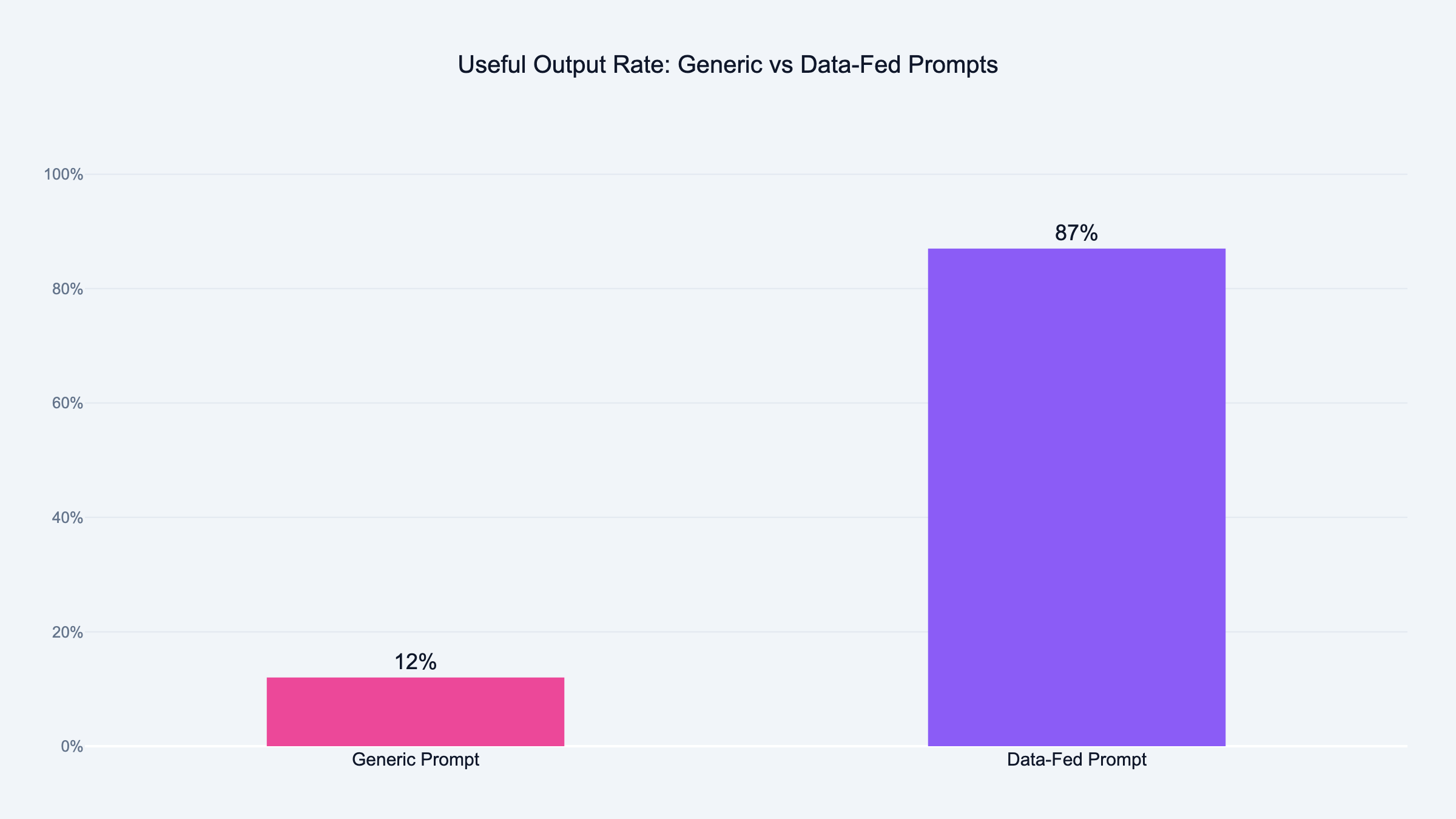
That prompt gives you 10 headlines that could apply to any SaaS product on earth. They will be generic. They will not convert.
The AI has no idea what your product does or who your audience is. It is guessing.
What a Good Prompt Looks Like
Here is what I actually use:
"You are a performance marketing analyst for a lead gen agency.
Here is 90 days of campaign data for Pablo's Facebook campaigns. [paste CSV]
Pablo sells online fitness coaching in Spain.
His customers are 25-40 year old professionals in Madrid and Barcelona.
His funnel: Facebook ad to landing page to free consultation call.
Current best campaign: 'ES-Broad-Fitness-Feb' at 8.2 euro CPL.
Worst: 'LATAM-Lookalike-Jan' at 3.1 euro CPL but zero sales.
What are the three biggest budget mistakes? Explain why the cheapest leads are not the best leads."
That prompt gives the AI everything it needs. Product, market, funnel, real numbers.
The output is night and day.
How I Structure Every PPC Prompt
I follow the same format every time. Four blocks. In this order.
Role:
Tell the AI what it is. "You are a senior media buyer managing 200K euro per month in Meta spend."
Data:
Paste the actual numbers. CSV export, campaign breakdown, date range. Real data, not made-up examples.
Context:
Client business, target market, funnel, what success looks like. Without this block, the AI chases cheap CPL into dead-end markets.
Question:
One clear question. Not five. Not "analyze everything." One thing at a time.
That is it. Four blocks. Every prompt.
Here is what all four blocks look like assembled into one copy-paste-ready prompt:
"You are a senior media buyer managing 50K euro per month in Google Ads spend.
Here is 90 days of campaign data for [client]. [paste CSV]
[Client] sells B2B software to HR teams in Germany and Austria. Their sales cycle is 30 days. One qualified demo request is worth 800 euro in expected revenue. Their best-converting campaign this quarter is 'DE-Brand-Exact' at 18 euro CPL. Their worst is 'AT-Display-Retargeting' at 94 euro CPL with zero closed deals.
Which three campaigns should I pause or cut before next week's budget review? Explain the business reason, not just the numbers."
That prompt takes 90 seconds to write. The output tells you exactly where the waste is.
The Prompts I Use Every Week
These are the actual prompts I run for real campaigns. Not theory. Not a list of 100 ideas.
"You are a performance marketing analyst.
Here is this week's campaign data for [client]. [paste CSV]
Compare this week's CPL to the 4-week rolling average.
Flag any campaign where CPL increased more than 20%.
For flagged campaigns, tell me what changed: audience fatigue, creative decay, or budget pacing."
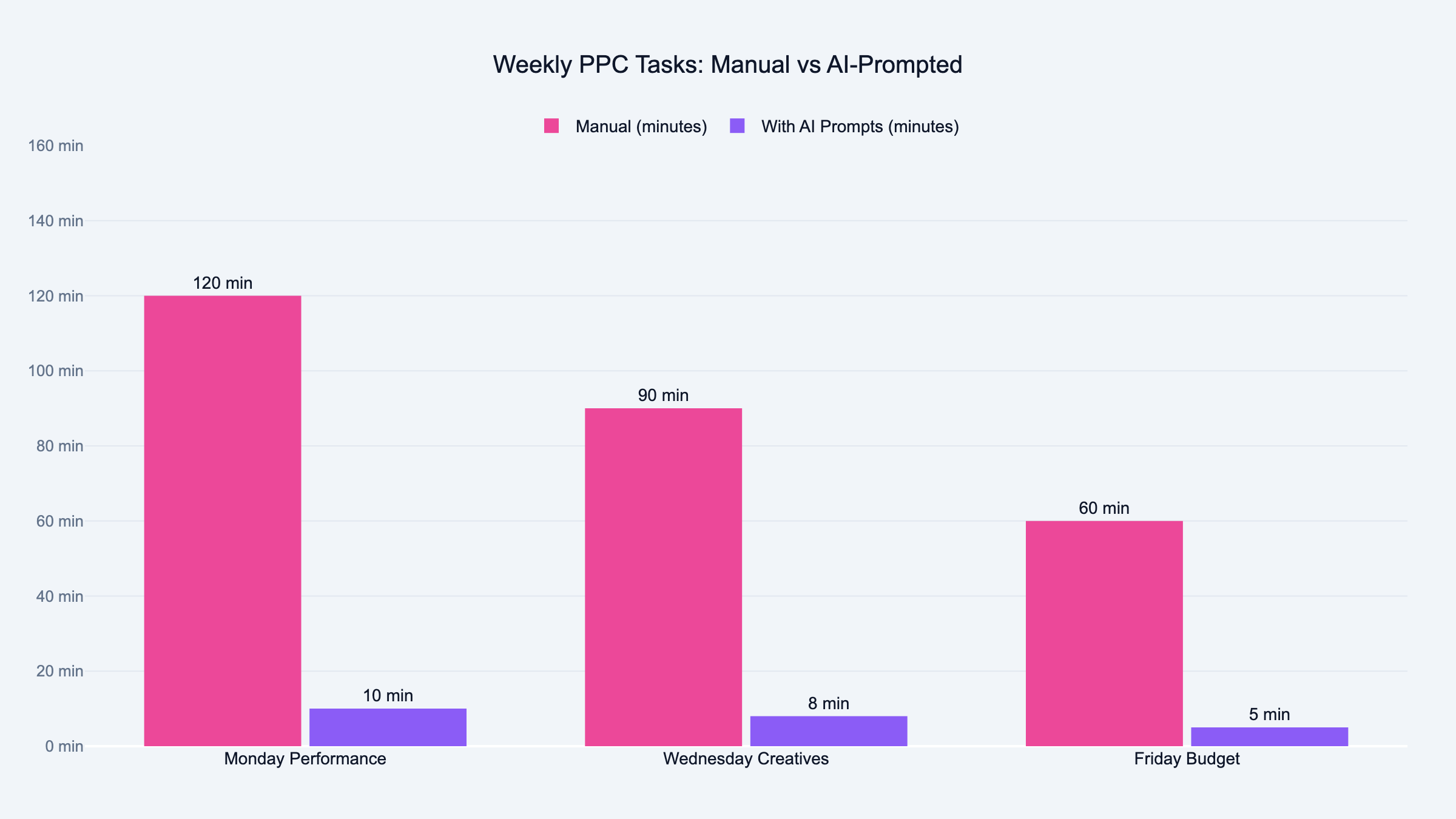
I run this every Monday morning. It takes 90 seconds. Victor used to spend two hours in spreadsheets.
The same system works for writing Google Ads copy with AI, not just analysis.
Wednesday: Creative Fatigue Check
"Here are the top 5 ad creatives by spend for [client] over 14 days. [paste data]
Which creatives show declining CTR week over week?
For any creative with CTR dropping more than 15%, suggest a new hook angle that still speaks to [target audience]."
Friday: Budget Reallocation
"Here is the full campaign breakdown for [client] this week. [paste CSV]
Rank campaigns by cost per qualified lead, not just cost per lead.
Recommend moving budget from the bottom 2 to the top 2. Show me the math."
Month-End: Full Account Audit
"You are a performance marketing analyst reviewing a monthly account for a PPC agency.
Here is the full account data for [client] for [month]. [paste CSV]
The client's goal is qualified leads under 40 euro CPL. Their sales team closes 1 in 8 leads.
Summarize performance against goal. Flag the two biggest problems. Recommend the one change that would have the most impact next month. Keep it to three paragraphs."
I send this output to Victor before every monthly client call. It takes him 10 minutes to review instead of 90.
Why Most Prompt Lists Are Useless
I read the top 10 articles ranking for "ChatGPT prompts for PPC" before writing this. I also wrote my own list of ChatGPT prompts for PPC managers with the context layer built in. Every single one of the articles ranking gives you prompts with no data attached.
"Write me Google Ads copy for a fitness brand." "Give me negative keywords for an e-commerce store." Those prompts produce the same generic output for every person who types them.
A prompt without data is a question without context. The answer will always be generic.
The fix is simple. Stop asking the AI to think. Start feeding it data and asking it to analyze.
That is the shift from "AI as writer" to "AI as analyst."
The Context Layer Most People Skip
Victor taught me something I did not expect. He has been running ads for over a decade.
He said, and these are his exact words: "I'm above average. I'm not the best, but I'm above many media buyers and I wouldn't see that."
He was talking about patterns the AI found in campaign data. Phase transitions, budget pacing problems, landing page conversion drops.
All hiding inside the overall numbers.
If an experienced media buyer misses these things, imagine a junior buyer prompting AI without context. The output is not just useless.
It is confidently wrong.
The context layer is the difference. Feed the AI your campaign history and your client's business model. Then ask your question.
How to Check AI Output Before Acting on It
I never act on AI analysis without checking three things.
Does the recommendation match what I know about the client? If the AI says "scale Latin America" for a Spain-only business, the context was missing.
Do the numbers add up? I spot-check the math. AI can misread CSV columns or confuse metrics.
Would I reach a similar conclusion with more time? If the AI suggests something I would never consider, I dig in before spending money.
Trust but verify. Every time.
For a deeper look at how Claude actually interprets campaign data behind the scenes, see my breakdown of how Claude reads campaign data like a senior media buyer. And for where all of this is heading in Google and Meta, see my guide on the future of PPC with AI.
Frequently Asked Questions
What are the best AI prompts for Google Ads?
The best prompts start with your campaign data, not a generic question. Paste your CSV export, add client context, then ask one specific question.
A prompt like "analyze my top 5 campaigns by CPL trend over 30 days" beats "give me Google Ads tips" every time.
Can ChatGPT write Google Ads copy?
It can, but only if you feed it the right inputs. Give it your best-performing headlines, your landing page, your target audience, and your key differentiator.
Without those inputs, it writes generic copy that sounds like every other ad.
How do I use AI to improve my PPC campaigns?
Export your campaign data as a CSV. Paste it into ChatGPT or Claude with your client context.
Ask specific questions: which campaigns are trending down, where is budget being wasted, which creatives show fatigue. Use AI as an analyst first.
Is AI good for Google Ads management?
For analysis and pattern spotting, it is excellent. It finds trends in 90 days of data faster than any human.
For strategy decisions, it still needs human judgment. I use AI to surface insights. I make the final call.
ChatGPT and Claude both handle campaign data analysis well. Export data from Google Ads, paste it in, and ask questions. No special setup needed. For a full walkthrough, see my guide on automating Google Ads reporting with AI.
For automated reporting, tools like Sucana connect directly to your ad accounts and analyze data without manual exports.
Do I need to learn prompt engineering for PPC?
If you manage ads for clients, yes. The difference between a generic prompt and a data-fed prompt is the difference between useless output and real insight.
Feed data first, add context second, ask one question third. That is the whole system.
How much time does AI save PPC managers?
My Monday reporting used to take two hours per client. With a structured prompt and CSV export, it takes 10 minutes. That is 90% less time on one task alone. I cover the full reporting workflow in my guide on automating client reporting with AI.
Creative analysis and budget recommendations add up to 6-8 hours saved per week.
Can AI replace a PPC manager?
No. AI cannot understand client relationships, business goals, or market context on its own. Victor's Pablo example proves this.
The AI recommended the exact wrong budget move because it lacked business context. AI makes a good PPC manager faster. It does not replace the judgment.
What is the biggest mistake PPC managers make with AI?
Prompting without data. They ask generic questions and get generic answers.
The fix: export your campaign data, paste it in, add your client context, and ask a specific question. The output changes completely.
How do I get started with AI for Google Ads today?
Export one client's campaign data from Google Ads as a CSV. Open ChatGPT or Claude. Paste the data.
Add two sentences about the client's business. Ask: "Which campaign should I pause based on the last 14 days?" That takes five minutes and shows you the difference right away.