



Sucana←Back to Blog
Sucana
PrivacyTermsTwitterLinkedInInstagram
agenciesanalyticsaifounder-story

The Sucana Story: How Three Founders Built an Ad Intelligence Platform From a Spreadsheet

February 25, 2026|18 min read
The Sucana Story: How Three Founders Built an Ad Intelligence Platform From a Spreadsheet

I'm Virgil Brewster, a Dutch marketer and consultant living in Bali. We started Sucana with Victor Chazarra and Vinod Sharma in June 2025 because Victor's agency was drowning in data.

Every tool he tried made it worse. We built the wrong product first, killed it, and found the real one. This is how it happened.

The Three Founders Behind Sucana

We're three people with different skill sets in different corners of the world. One shared frustration.

I've spent 20 years building and launching businesses. Most of them worked. Some didn't. All of them taught me something.

I'm fifty-one years old. One more build and I'll retire. Nah, just kidding. But at some point you have to be aware that you don't have all the time in the world anymore.

And that's fine..

Virgil Brewster, co-founder of Sucana

Victor Chazarra runs a lead generation PPC agency. He also lives in Bali, two minutes from my place.

He manages campaigns across Google Ads and Meta Ads for multiple clients. Handles everything: client calls, campaign strategy, creative production, reporting.

Victor Chazarra, co-founder of Sucana

Vinod Sharma is a product builder based in Florida who came back to coding after 12 years in management.

Code runs in his blood. We've never seen a problem he couldn't solve. He builds things most people don't even know are possible. The time difference between Bali and Orlando means somebody is always awake, always building.

Vinod Sharma, co-founder of Sucana

When we go to sleep, Vinod is just getting started. When Vinod wraps up, we're already on calls with Victor over coffee.

That's the founding team of Sucana. Two guys in Bali, one in Florida, building across time zones like it's the most normal thing in the world.

From a First Call to a Lunch That Changed Everything

In March 2025, Vinod and I started talking. We had this shared itch to build something together.

He was in Orlando, I was in Bali, and the calls started. Just two guys with ideas and a lot of energy.

By April, we were knee-deep in building chat functionality. No product yet, no name, just code and late-night calls.

Then May 2025 happened.

I sat down for lunch with Victor. Nothing formal. Just two guys who live two minutes apart in Bali, eating lunch.

Victor started talking about his agency. The two full days every week he lost to exporting numbers that didn't match. He described his Monday and Tuesday routine, and I could see it in his face.

This wasn't a minor problem. This was a guy who loved running ads but hated everything that came after.

By the time we finished eating, I knew this was the guy. He had the problem. Vinod had the skills to build the solution. And I knew how to get it in front of the right people.

And that's how Sucana was born.

Victor's Spreadsheet Problem

Every Monday and Tuesday, Victor sat in front of his computer doing the same thing.

Open Meta Ads Manager. Export the data. Open Google Ads. Export the data. Open Google Sheets. Paste the data. Run the formulas. Fix the broken cells. Cross-reference with the leads sheet.

Two full days. Every single week. And the worst part? The spreadsheet broke all the time.

He told us once:

"It's very easy in a Google Sheet to touch a cell and break everything or have report errors and drag those errors forward."

One wrong click. and suddenly, the data your client is paying you to track is wrong.

Victor built his own Excel sheet to try to figure it out. Custom formulas. Pre-saved reports in Meta and Google that matched his spreadsheet columns.

Webhooks through N8N to capture leads automatically. He did everything right. He engineered his own system from scratch because nothing on the market worked the way he needed it to.

When he showed it to his PPC agency friend they went wild.

"I would pay for this they said."

Bur It still wasn't enough.

Meta showed one number. Google showed another. The Stripe account showed something different again.

The pixel data was skewed. Nothing matched. And he had to explain all of this to his clients every week.

That's not running an agency. That's being a full-time data cruncher.

The Wrong Product and the Courage to Kill It

Sucana didn't start as a data analytics platform.

From June through August 2025, all three of us were building a video ad creator. Vinod coding from Orlando, Victor and I pushing ideas from Bali.

The idea was to help agencies produce video ads faster. But not random ads like most tools out there.

But based on Victors Lead gen system that had sold $15M for his clients. His concept was to identify the right awareness levels. And scale winning creatives with different hooks and angles. In a nutshell.

We had wild plans. An all-in-one agency OS.

It sounded great on paper.

We were excited. Vinod was building features. Victor was testing workflows. I was writing positioning. We spent the entire summer on it.

But something kept nagging at us.

Around September 2025, we had our first formal three-way Zoom meeting. And something clicked during that call.

The video creator was great, it worked. But it wasn't the thing. Victor's real problem, the one that kept him up at night, the one he complained about over lunch, the one he built his own Excel sheet to solve, was still there.

His spreadsheets. His broken reports. The hours disappearing into manual work every single week.

Vinod has a cool marble analogy.

Building a startup is like pulling marbles out of a jar. You reach in, pull one out, look at it, and say: "Is this the one?" Most of the time, it's not.

You put it back. You pull another. And you keep going until you find the one that lights up.

The video creator wasn't the magic marble.

Until one evening Victor and Vinod decided to build a tool around Vic's spreadsheet.

At our next meeting Victor showed me what they build. His face lit up from excitement. Something that I hadn;t seen in a long time in him.

So the decision was made. We parked the video and the hooks idea, and went all in on Data analysis, or attribution how the fance PPC guys say it.

Three months of work, gone.

But for the first time in months we had laser focus. And we went to work.

It takes courage to kill something you've been building. But adding features is easy.

Removing them is a whole different ball game. And removing an entire product? That's the hardest call you can make.

But it was the right one. Here's why…

Agencies Are Drowning in Data

The problem we set out to solve isn't that agencies lack data.

It's the opposite. They have too much of it, spread across too many platforms, and none of it agrees with itself.

Victor described it simply: Agencies are drowning in data.

His workflow had three different data sources. Spend data from Meta and Google. Lead data from his webhook system.

Client data from his CRM. To get one complete picture, cost per lead for example, he had to manually combine all three.

Pivot tables for spend. Manually typed lead counts next to each row. Manually added the sales numbers. Human joins. By hand. Every week. And if one cell was wrong, everything downstream was wrong too.

That's what most agencies do. Not because they want to. Because the tools don't talk to each other.

Victor runs a lead generation PPC agency. That's what he breathes. That's what he knows.

When we build Sucana, we build for that reality. For agencies like his, solving the problems he lives every day.

And now we share our solution with the world.

Building at the Speed of Three

After we killed the video creator in October 2025, Vinod built the first data analytics version in about 2 weeks. Coding until midnight his time, which meant we'd wake up in Bali to a wall of updates and new features ready to test.

Vinod is the kind of developer who won't sleep until the bug is fixed. When he hit the Meta API and discovered that Meta's "Results" column doesn't actually exist as an API field, he didn't complain.

He reverse-engineered the logic. Meta calculates that column client-side in their own interface. It's not exposed in the API. Any analytics tool that wants to show "Results" has to figure out how Meta does it and build the same logic from scratch. Vinod did it overnight.

Victor tested every feature by running his actual client campaigns through Sucana. He wasn't gentle about it either. He's always happy to shoot holes in our tool.

And trust me he did that hundreds of times.

When we built dropdown filters for platforms, campaigns, and conversion types, Victor used them and got confused. The filters created complexity instead of clarity. PPC agencies don't have time to learn dropdown logic. They have campaigns to run.

So we killed the filters.

We replaced everything with natural language. Instead of clicking through menus, Victor just typed: "Show me October campaigns." Or: "What drove conversions last week?"

That's the philosophy. If you need training, it's too complex. Simplicity always wins.

By December 2025, we had a working MVP.

By January 2026, we were prepping for a first round of beta tester. And by February 2026, ads were live. Real campaigns running through Sucana. Daily team meetings across Bali and Orlando. Beta testers putting the product through hell.

The Moment Victor's Face Lit Up

We worked on Sucana for months. Multiple iterations. Different directions. We kept asking Victor, "Would you use it?"

He would say yes. But never enthusiastic.

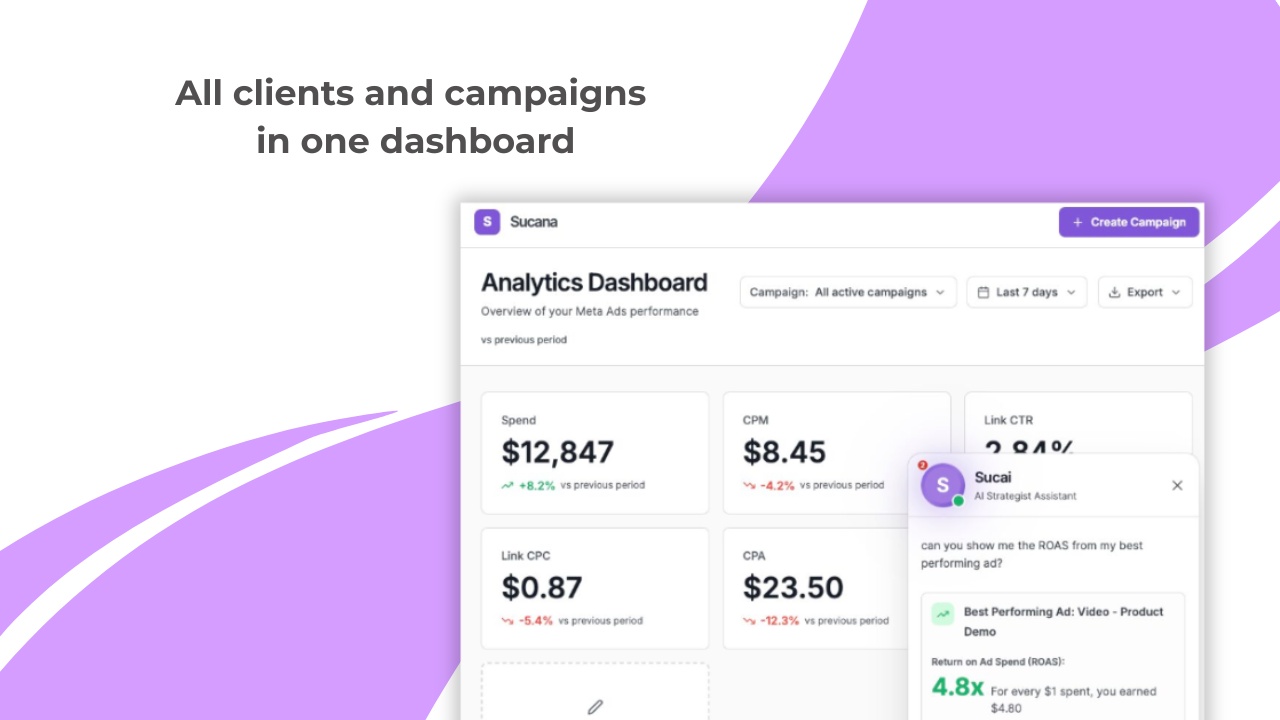
Then we built the analytics feature. The one where you can talk to your data and it talks back. For the first time, Victor could pull data across all time ranges. Cross-check data with other data. Compare between different clients from one dashboard.

His face lit up.

His exact words: "This is fucking amazing."

That captured everything.

For the first time, he could ask his data a real question and get a real answer. Not a dashboard full of numbers. An actual answer. In plain language.

"What was my ad spend in May 2025 versus January 2026?"

"Which ad copy performed the best?"

"How long does it take before someone who saw my ad buys?"

The AI doesn't just show numbers. It understands what you're asking and gives you an answer you can act on. In a way that your client would understand if you forwarded it to them.

Sucana analytics dashboard with AI chat — all clients and campaigns in one view

Even if nobody else ever sees Sucana, we already won in that moment. Victor saw his data come alive.

And we believe that when we show Sucana to agencies who operate just like Victor, who have the same problems, chances are high that they'll respond the same way.

Built by an Agency, for Agencies

If you run an agency, you know the feeling.

Monday morning, you open your laptop, and instead of running campaigns, you're wrestling with spreadsheets.

Pulling data from Meta. Pulling data from Google. Pasting it into a sheet. Fixing broken formulas. Building pivot tables by hand. And then doing it all again for the next client.

Your client calls. They want to know what you did last week, what you spent, and what you're doing next. You should be able to answer that in 30 seconds. Instead, it takes two days of manual work just to get the numbers straight.

We know because Victor lives that exact life.

He runs the agency. He knows what breaks at 2 AM before a client call. He knows which metrics actually matter when you're managing 15 accounts and your spreadsheet just corrupted. He knows that the client doesn't care about CTR or CPM. The client wants clear answers.

That's why we built Sucana the way we did. Every feature exists because Victor needed it.

The AI chat that understands campaign context. The end-to-end data tracking from ad to landing page. The weekly reporting that answers those three questions your client keeps asking.

We don't build features because a product roadmap says so. We build them because the agency on the other side of the table can't operate without them.

We built Sucana so you can stop being a data janitor and go back to doing what you're good at. Running campaigns. Growing your clients. Living your life.

What 235 Agencies Taught Us

We started talking to agencies early. Not surveys. Real conversations. One agency owner at a time.

Over the course of building Sucana, we had conversations with 235 agencies. Victor's network in Spain opened the first doors. Then word spread.

The conversations revealed something deeper than we expected.

Agencies aren't just frustrated with their tools. They're burned out by them.

One agency owner told us he buys tools and forgets he even has the subscription. Another said she spent more time setting up her reporting dashboard than actually running campaigns for clients.

The agencies doing $3,000 a month in ad spend had the same data problems as the ones doing $3.5 million. The tools didn't talk to each other. The pixel data didn't match reality. The reports took forever. The problem is the same at every level.

And agencies talk to each other. They share tools. They warn each other about bad experiences. They move in groups. They don't see each other as competition. That's a beautiful thing about this industry. If the product is great, agencies will tell other agencies.

Word of mouth in a tight community is the most powerful marketing channel you can have.

That changed our entire distribution strategy. We're not trying to outspend competitors on ads. We're trying to build something so good that the community does the talking for us.

Why We Build This in Our Forties and Fifties

I'm 51. Vinod is 50 and Victor is in his forties. We're not fresh out of college chasing a quick exit.

We've always wanted to build software. For me, I wasn't smart enough before. Everything else felt like work. For Victor, he spent years solving his agency's problems with duct tape and spreadsheets, waiting for a tool that never came.

At this stage in life, you realize something. You can't jump on new opportunities for the next 50 years. Life is going to end. That's not a bad thing. That's a good thing.

That realization gives you fuel. It strips away the noise and forces you to ask: what do we actually want to build? What do we believe in enough to go all the way?

And then AI happened.

The tools we couldn't build two years ago, we can build now. Vinod writes code with AI assistance.

Our entire SEO pipeline runs on automated skills. I deployed a blog to production, pushed code to GitHub, auto-deployed to Vercel, and I didn't even realize I was committing code.

A non-technical 51-year-old founder pushing production code. That's the world we're in.

What would have taken a team of 10 engineers and 18 months, three founders can build in weeks. Connected by Zoom and WhatsApp and a shared belief that agencies deserve better tools.

Three Founders, No Investors, One Mission

Most SaaS founders build from the outside looking in. They spot a market opportunity, raise money, hire a team, and build a product they've never personally used.

We built from the inside looking out.

Victor is the customer. He doesn't just "understand the pain." He lives it every day. When he tests Sucana, he's not running a QA checklist. He's running his actual business through it. If something breaks, his clients feel it.

Vinod doesn't just write code. He builds systems that make the impossible look simple. When Meta's API returned data in a format nobody expected, Vinod didn't file a ticket. He reverse-engineered the solution that same night from his desk in Orlando.

And me? I'm the one who says "Let's fucking go" at 7 AM and doesn't stop until the work is done. I spent 20 years consulting for agencies. I know what they need. I know how they talk. I know what makes them trust a product and what makes them walk away.

Together, we cover every angle. Product, engineering, distribution. No investors telling us to add features we don't believe in. No board meetings. Just three founders building the thing that Victor's agency, and thousands of agencies like his, actually needs.

Agencies lose 96 hours a year on manual reporting alone. The data silos between platforms create blind spots that cost real money. And the reporting gap between what agencies show and what clients need is the number one reason agencies lose clients.

We know because we've lived it. And now we're building the fix.

The Vision

We want people to say that Sucana is life-changing for their business. That it gives them back something more valuable than their own weight in gold.

Time.

When you have time, you can free your mind. Think about expanding your business. Step out of the day-to-day. Spend more time with your family.

Sucana should give you freedom. Freedom of choice. Freedom to do whatever you like while doing what you love the most: running your agency.

Not drowning in spreadsheets. Not fighting with broken formulas. Not spending two days every week on reporting that could be done in minutes.

We don't reach for the stars. We reach for the heavens.

And right now, we're building. Every day. Victor tests real client campaigns through Sucana from Bali. Vinod pushes code from Orlando. I'm doing what I do best: getting this in front of the agencies who need it.

If you're an agency owner who's tired of drowning, help is on the way.

Not from a marketer or a business developer. From agency owners who solved their own problem and now want to share it with the rest of the community.


Frequently Asked Questions

Who founded Sucana?

We are three co-founders: Virgil Brewster, Victor Chazarra, and Vinod Sharma.

We started Sucana in 2025.

Virgil and Victor are based in Bali, Indonesia. Vinod is based in Orlando, Florida.

Virgil brings 20 years of marketing and business building experience. Victor runs a lead generation PPC agency and provides real-world agency expertise. Vinod is the developer who builds the platform.

What does Sucana do?

Sucana is an ad intelligence platform for lead generation and e-commerce agencies.

We connect ad platform data from Google Ads and Meta Ads into one dashboard. We track performance from the ad to the landing page.

Agency owners can ask questions about their data in plain language. The AI responds with clear answers you can act on.

How was Sucana created?

We started in June 2025 when all three founders began building together.

Virgil and Vinod had been talking since March. Victor joined after a lunch meeting in Bali in May.

From June to August 2025, we built a video ad creator. We pivoted in September when we realized Victor's real pain was data fragmentation, not video production.

From October to December 2025, we built the data analytics MVP.

By early 2026, Sucana was live with real client campaigns running through it.

What problem does Sucana solve for agencies?

Agencies waste hours every week on manual reporting because their ad data is scattered across platforms.

Spreadsheets break. Numbers don't match. Reports take forever to build.

We solve this by pulling all data into one place, keeping it accurate end-to-end, and generating reports in minutes instead of days.

Is Sucana only for lead generation agencies?

No. Sucana serves both lead generation and e-commerce agencies.

Victor runs a lead gen agency, so that's where we started. But the data problem is the same across both worlds.

We built Sucana for the workflows, metrics, and challenges that agencies face daily, regardless of whether they run lead gen or e-commerce campaigns.

How is Sucana different from Hyros or Ruler Analytics?

We built Sucana as an ad agency for ad agencies. Tools like Hyros and Ruler Analytics serve a broader marketing audience.

We focus on simplicity. Flat pricing without success fees. Fast support response in 6 to 8 minutes. An AI that understands agency-specific questions.

If you need to know cost per lead across multiple clients from one dashboard, Sucana does that without a complex setup process.

Where is Sucana based?

Sucana operates across two time zones. Virgil Brewster and Victor Chazarra are based in Bali, Indonesia. Vinod Sharma is based in Orlando, Florida, United States.

The team works asynchronously. When Bali sleeps, Orlando builds. When Orlando wraps up, Bali is already testing and shipping. This setup means someone is always working on Sucana.

When was Sucana founded?

Sucana was founded in 2025. The first conversations between Virgil and Vinod started in March 2025. Victor joined after a lunch meeting in Bali in May 2025.

The team started building together in June 2025. After a pivot in September 2025, the data analytics MVP was built from October to December 2025.

Beta testing began in January 2026 and ads went live in February 2026.

Is Sucana bootstrapped?

Yes. Sucana is fully bootstrapped with no outside investors. Three founders fund and build the company themselves.

There are no investors telling the team to add features they don't believe in. No board meetings. No fundraising rounds. Every decision is made by the people who build and use the product daily.

What ad platforms does Sucana support?

Sucana currently connects to Google Ads and Meta Ads (Facebook and Instagram). These are the two dominant ad platforms used by lead generation and e-commerce agencies worldwide.

The platform pulls spend data, campaign performance, and conversion metrics from both platforms into a single dashboard. Additional platform integrations are on the roadmap.


agenciesanalyticsaifounder-story

Related Articles

How Claude Reads and Paints Data Like a Senior Media Buyer
ai

How Claude Reads and Paints Data Like a Senior Media Buyer

Mar 9, 2026|11 min read
AI for Facebook Ads: What's Actually Worth Using
ai

AI for Facebook Ads: What's Actually Worth Using

Mar 9, 2026|11 min read
How to Pitch AI Services to Agency Clients (2026)
ai

How to Pitch AI Services to Agency Clients (2026)

Mar 8, 2026|10 min read