I built a full system for proving marketing ROI with AI. The same principles apply to measuring AI inside your agency.
The Part Nobody Talks About
AI breaks. Often.
We opened Sucana for testing on March 2. Full team call.
Victor typed a message and the screen reset. Nothing.
Vinod checked the backend. Same error.
It was not us. Claude's API was down everywhere.
Every business built on that tool lost an hour of their day.
That moment taught me something. Building on someone else's technology is a dependency. You need a plan for when the AI goes down.
For us, Victor can still run his reports manually. The old process is slower, but it works. We parked the boats nearby instead of burning them.
The agencies that go all-in on AI with no manual fallback are one outage away from missing a client deadline.
What an AI-Powered Agency Looks Like in Practice
The daily reality is less dramatic than the articles make it sound.
Monday morning, I check what the AI analyzed over the weekend. Campaign performance, geographic spend patterns, creative fatigue signals.
Fifteen minutes instead of two hours.
Then I look at what the AI flagged. A CPL spike in one market, a creative running three weeks without a refresh.
Budget that shifted to Display when the client wanted Search.
The AI surfaces things I might miss. I make the calls.
That is the model. A layer of AI doing the heavy data work so humans can focus on judgment and client relationships.
Victor put it well. The AI does not just recommend the best-performing number.
It recommends the one you can iterate on without breaking your production budget.
That kind of thinking separates a useful AI workflow from a tool that sounds good in a demo.
Where to Start
If I had to start over today, I would do four things in the first month.
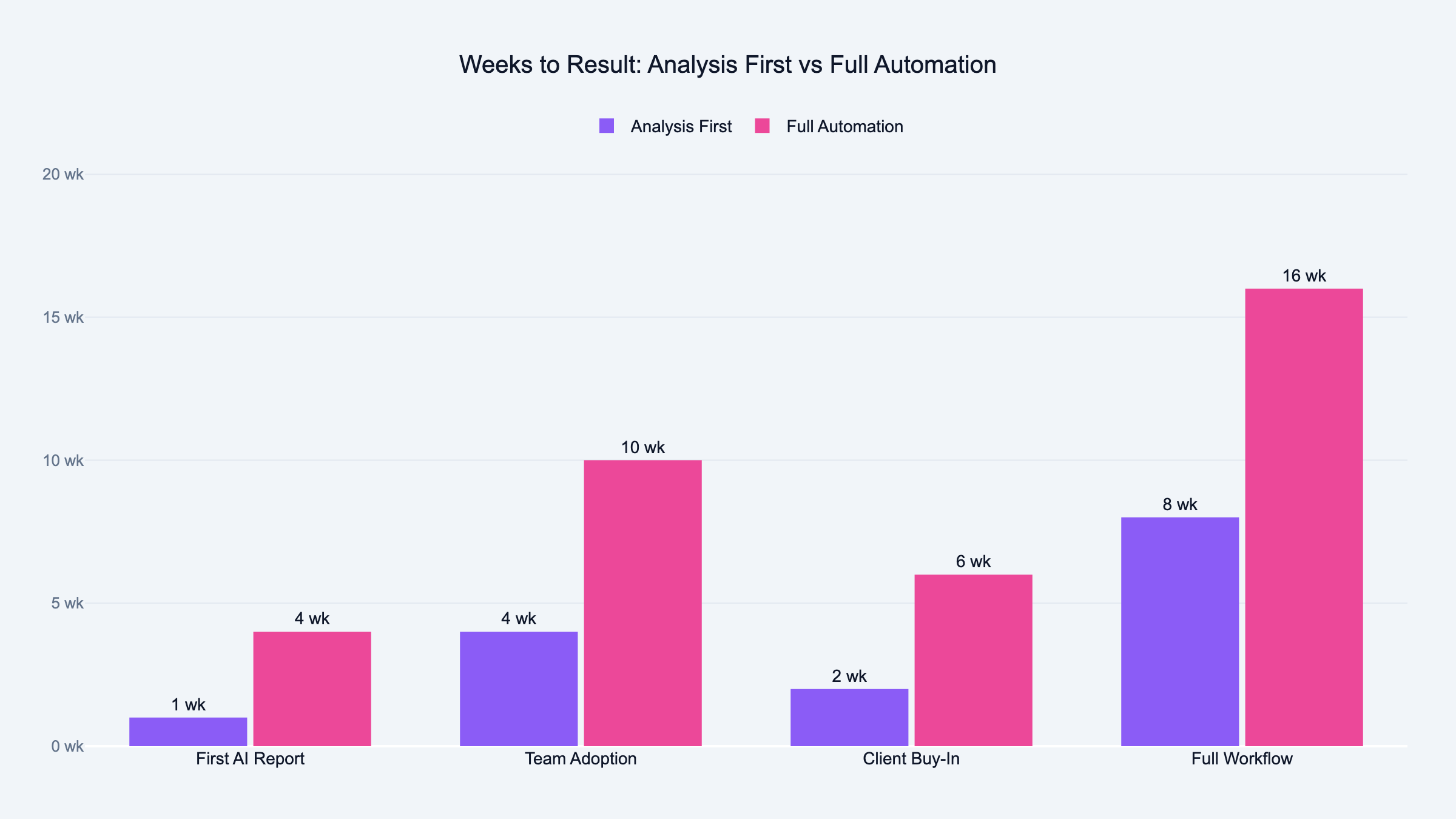
Week one: find the bottleneck. List every task your team does weekly. Pick the one that takes the most hours, follows the same steps, and produces output clients see. I walk through this exact process in my guide on where agencies should start with AI automation.
Week two: automate that one task. Use Claude, ChatGPT, or whatever tool fits. Build a simple workflow. It will not be perfect. That is fine.
Week three: test and fix. Run it alongside the old process. Compare the output. Fix what breaks. Let your team get comfortable with it.
Week four: measure. Put the old time and the new time side by side. If the numbers work, roll it out for real. If not, fix it before moving on.
One month. One task. One win.
Do not build an agency OS. Do not automate five things at once. Do not follow the YouTube kid who says he built it all in a weekend.
Start small. Get your people used to it. Then expand one task at a time. When you are ready to go further, I documented how I built a full AI brain for the agency using Claude Code — the architecture, the skills, and how it all connects.
Frequently Asked Questions
How do you build an AI-powered marketing agency from scratch?
Start with one repeatable task, not with AI tools. Identify the workflow that eats the most hours every week, usually reporting or data analysis.
Build one AI workflow for that task. Test it with one client for 30 days.
Measure the savings, then expand.
What AI tools do marketing agencies actually use?
Most agencies use Claude or ChatGPT for campaign analysis and ad copy. Automation platforms like n8n or Make handle data connections between ad platforms and reporting tools.
The tools matter less than how you use them. A $20 Claude subscription with good prompts beats a $500 platform with generic ones.
How do you pitch AI services to agency clients without scaring them?
Never lead with the technology. Lead with the result. "We catch campaign problems in three days instead of two weeks" is a pitch.
Show clients a report with depth they have never seen. The reaction will be about the insight, not about what produced it.
How much does it cost to add AI to a marketing agency?
The tools cost $20 to $40 per month. Automation platforms often have free tiers for small volumes.
The real cost is setup time. Expect four to six weeks of building and testing your first workflow. Budget 30% of time savings for ongoing human review.
Will AI replace marketing agencies?
AI will replace tasks that involve pulling data, formatting reports, and generating ad copy at scale. Those are already faster with AI.
Strategy, client relationships, and judgment calls about what the data means are still human. The role changes shape, but agencies that add AI get stronger.
How do you automate client reporting with AI?
Pull campaign data into a structured format. Feed it to AI asking three questions: what happened, why, and what to do next.
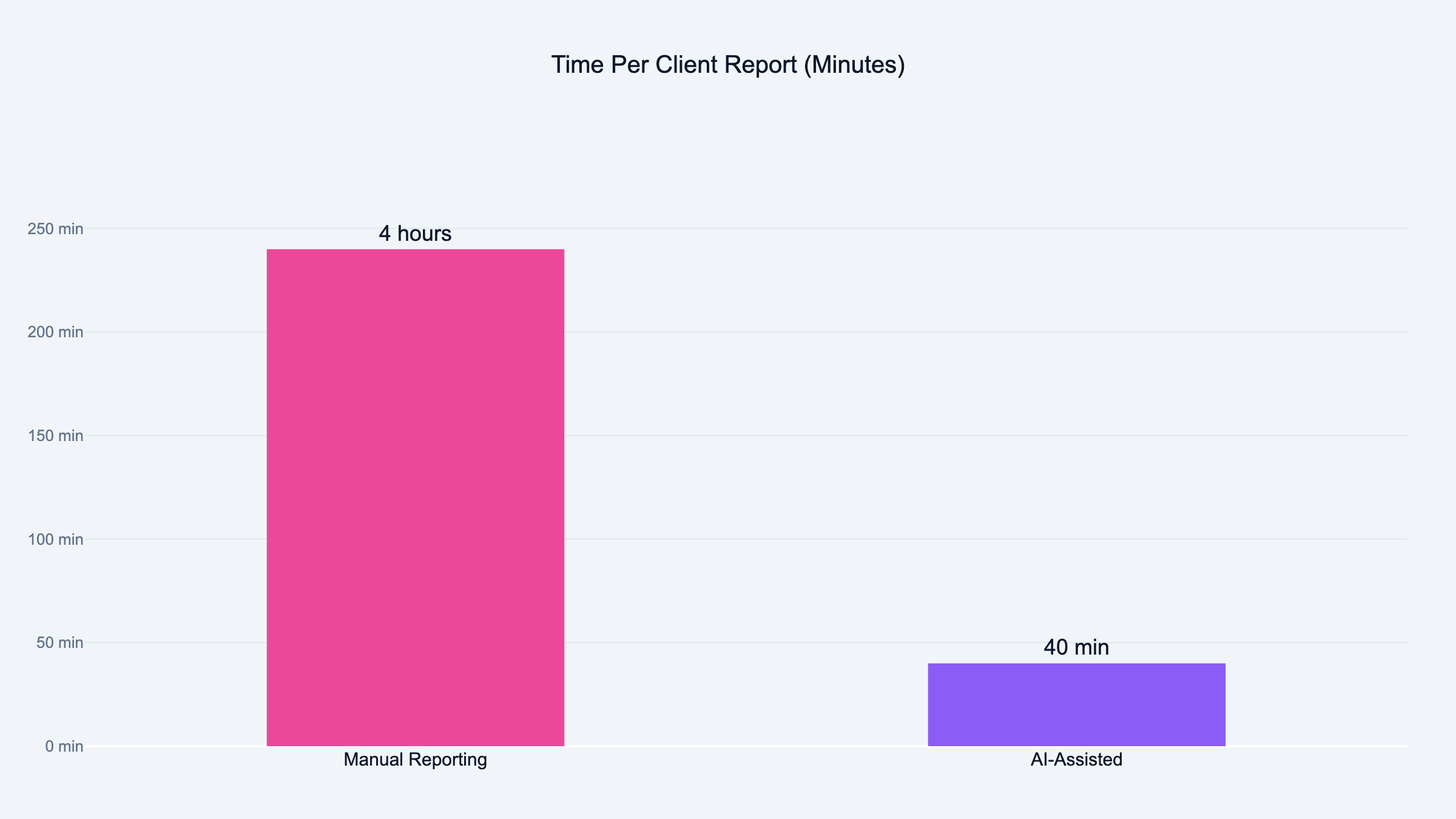
The process takes about 40 minutes per client instead of four hours. AI handles data reading while you add context and judgment.
What tasks should agencies automate with AI first?
Start with reporting. It runs every week, follows the same format, and the output is visible to clients.
Stay away from creative strategy and client communication early on. AI needs patterns and structured inputs, and strategy gives it neither.
How do you train a marketing team to use AI?
Do not start with training. Start with one person and one task. Pick the team member who complains most about their workload.
Build one workflow. Let them use it for 30 days. When they share the time savings, the rest of the team follows.
How do you price AI-powered agency services?
Do not discount because AI does some of the work. The value to the client stays the same no matter what produced it.
Price based on the outcome. Deeper analysis, faster problem detection, better recommendations. Catching a budget leak in three days instead of fourteen is worth more, not less.
What is the ROI of AI for marketing agencies?
AI cuts reporting time by about 75% in our experience. What took two hours per client now takes about 40 minutes.
The real ROI is what you do with the saved time. Deeper analysis, faster problem detection, and catching issues before clients notice them.
What happens when the AI gives wrong answers?
It happens regularly. AI produces drafts, not finished work. Every output needs a human check.
Track error rates monthly. If wrong answers climb, your prompts need better context. Feed the AI your client's business details, not just campaign data.
Can a small agency compete with large agencies using AI?
Small agencies have the advantage. New tools get adopted the same day. Large agencies need months of procurement and approvals.
Three people with AI and clean data can produce analysis that matches a ten-person team doing everything by hand.
How long does it take to see results from AI in an agency?
Reporting improvements show up in the first week. Your first AI report will be faster and more detailed than your manual process.
Campaign performance improvements take 60 to 90 days as the AI spots patterns across enough data.
What is the biggest mistake agencies make when adding AI?
Automating everything at once. AI bidding, AI copy, AI reporting, and AI creative testing in the same week. Impossible to tell what is working.
Add one AI layer at a time. Start with reporting, measure the result.
Then add the next layer.
Do clients care whether their agency uses AI?
Most clients care about the result, not the tool.
When they see their own data explained at a depth they have never experienced, the AI question disappears. Results first, always.