How do I save 2 hours a day on LinkedIn DMs with Claude?
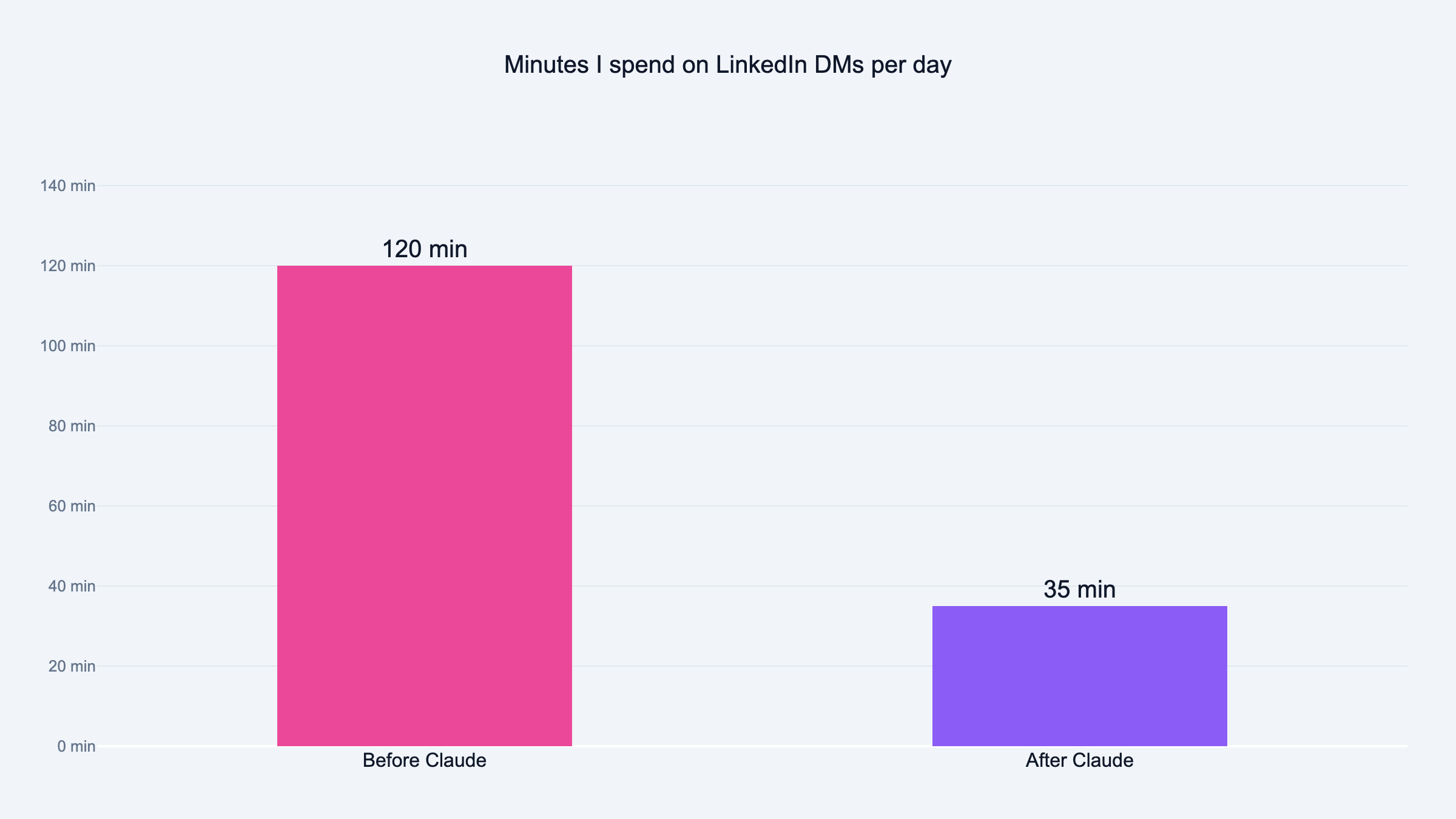
Claude reads every new DM, triages by urgency, drafts a reply in my voice, and sets the follow-up reminder. I approve before anything sends. Two hours back every morning, same quality DMs as before.
The Morning Inbox That Broke Me
6am. Bali sun barely up. Coffee.
I open LinkedIn. 10 new DMs from overnight.
9 of them start the same way. "Hi Virgil, I came across your profile and was impressed by your work at Sucana."
Same opener. Same pitch three lines down. You can smell the template.
1 of them is a real human. She asked a question about Sucana's onboarding that nobody could ask without reading my latest post.
Guess who got a reply.
That's the whole game in one morning.
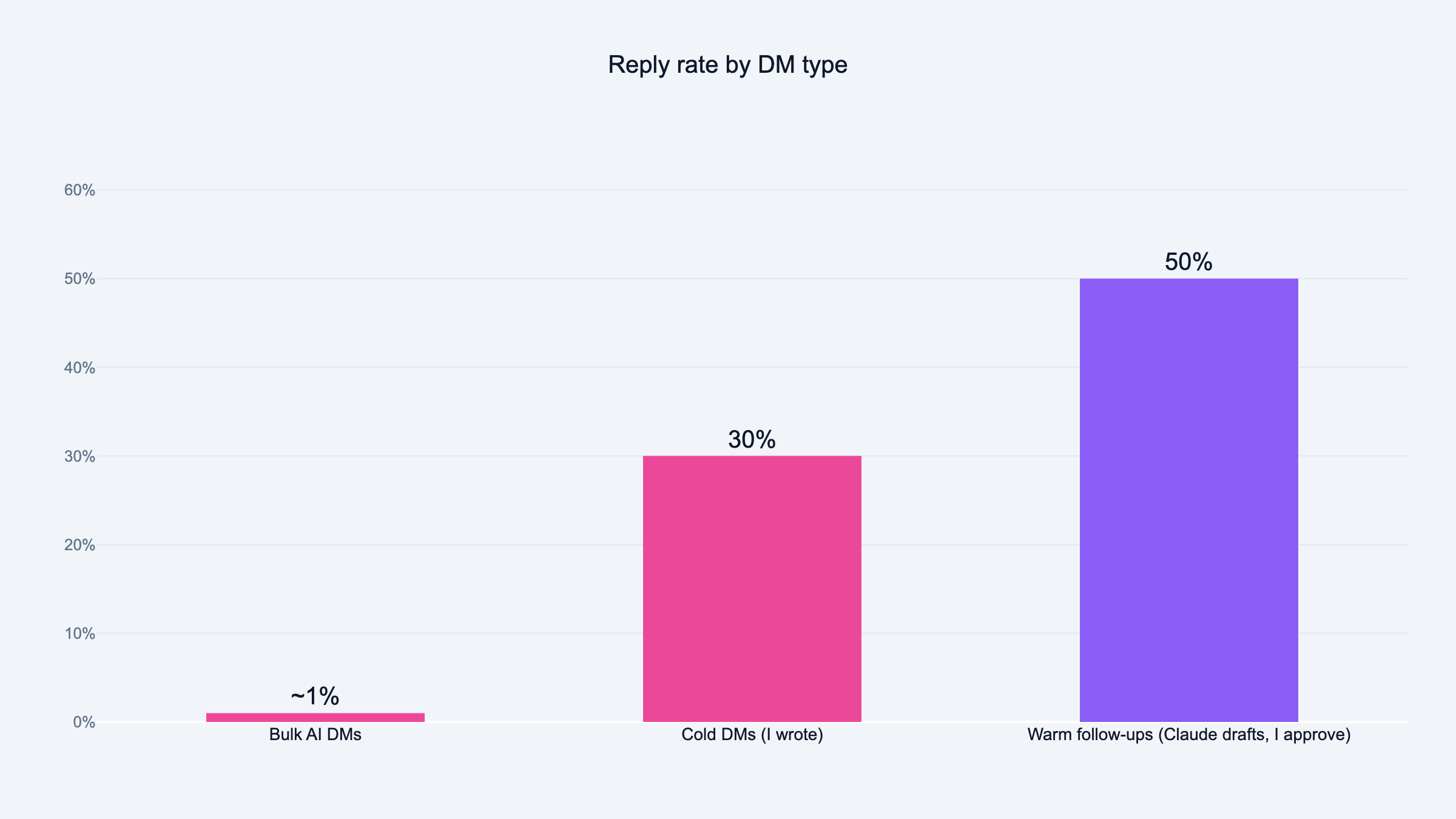
Every marketer sending 500 DMs a week thinks they're clever. Their reply rate is probably under 1%. Quality DMs still win.
But the problem with quality DMs is the admin around them. Finding the right prospect. Remembering what they said last month.
Knowing when to follow up. Knowing what to follow up with.
Two hours a day on LinkedIn isn't writing. It's tracking.
Claude doesn't write my messages. Claude handles the tracking. That is the whole trick.
Why I Did This
For two years I did LinkedIn DMs the old way. Inbox open in one tab. Notion in another. Calendar in a third.
Every morning I'd scroll, remember, copy, paste, schedule, repeat. By 8am I was drained and the writing had not started.
Then I ran the math. 2 hours a day, 5 days a week, 50 weeks a year. 500 hours. A quarter of my working year gone to admin that nobody sees and nobody pays for.
Victor, my co-founder, said it first. "You are the business. If you are stuck in DM admin, the business is stuck."
So I built a stack where the admin disappears and my time goes back into the one thing that moves the needle. Real conversations with real people.
What I Built
A two-part stack.
Kondo handles LinkedIn. It pulls every unread thread, tags it with a stage, keeps the full history searchable, and syncs in real time. No browser tab scraping. No Chrome extension surprises.
Claude Code sits on top of Kondo. Every morning I tell it "pull the inbox."
Claude reads every new thread. Sorts them by stage and urgency. Tells me which 5 to reply to first. Drafts each reply in my voice using the thread history. Sets the follow-up reminder for the ones that need one.
I never send a DM Claude wrote without reading it. Claude drafts. I approve, rewrite, or kill. I hit send. That loop is the product.
Before You Start
You need four things before anything runs.
-
A LinkedIn account with real thread history. Brand new accounts get rate-limited and shadow-flagged when you try to pull inbox data. Use the account you already post from.
-
A Kondo account connected to that LinkedIn. Kondo is a LinkedIn DM tool that pulls your inbox, tags threads by stage, and exposes the data Claude reads. Free tier works for getting started.
-
Claude Code installed on your laptop. Not the chat app. The CLI tool that runs inside your terminal and can read files. If you have never used it, the setup is one install command. (Here is why I run my marketing on Claude instead of ChatGPT.)
-
A voice file. One markdown file with your banned words, cringe phrases, real example sentences, and the words you love. Without it, Claude drafts stay generic. With it, they sound like you wrote them tired on a Monday.
Skip any of the four and the stack does not work.
Step 1: Connect Kondo to Your Inbox
Open Kondo. Sign in with LinkedIn. Let it pull your inbox. First sync takes 10 to 15 minutes depending on how many threads you have.
Open Claude Code in your terminal. Point it at the folder where you want the DM workflow to live. I use ~/dm-workflow.
Type the prompt:
I want you to read my LinkedIn DM inbox from Kondo.
Show me all unread threads with:
- The person's name and headline
- The last message they sent
- Date of the last message
- Current thread stage (if Kondo has one tagged)
Sort by date, newest first.
Claude pulls the inbox. You see your threads in the terminal. That is the entire integration. No code you write. Claude does it.
Step 2: Triage Every Thread By Urgency
Kondo lets you tag threads, but manually tagging 200 threads is the opposite of saving time. Let Claude do it.
Triage is about urgency, not labels. Every thread is in one of four states. Is there a question waiting on me? Is the thread stale (no activity in 7+ days)? Is this a new lead I have not answered yet? Is this a follow-up I promised and missed?
Type the prompt:
For each thread in my Kondo inbox, read the last 5 messages.
Label each thread with one of these states:
- WAITING_ON_ME (they asked, I owe a reply)
- STALE (no activity in 7+ days, was warming up)
- NEW_LEAD (first message to me, not answered)
- FOLLOWUP_DUE (I said I'd circle back and the date has passed)
- PARKED (nothing to do right now)
Update the Kondo tag on each thread so future-me can see the state at a glance.
Then show me a count of threads in each state.
Claude reads every thread. Tags every one. Shows you a count.
The first time I ran this I had 214 threads. It took 4 minutes.
The summary was brutal. 140 PARKED. 50 STALE. 18 WAITING_ON_ME. 6 NEW_LEAD.
I had 24 threads that needed action. The other 190 were noise. That count in one screen replaced an hour of scrolling.
Step 3: Pull the Morning Priority List
Not every thread on that list needs a reply today. Claude sorts.
Type the prompt:
Show me the 5 threads I should reply to first this morning.
Rules:
- WAITING_ON_ME threads with a direct question: top of list
- FOLLOWUP_DUE threads where I promised a specific date: next
- NEW_LEAD threads from the last 48 hours: next
- Anything older than 10 days in STALE: deprioritize (may be dead)
For each thread, show me the person, the last message, and one sentence on why it's a priority today.
Claude gives you 5 names. 5 reasons. You know exactly where to start.
Everything else goes in a backlog you deal with after the 5 priority threads are done.
Step 4: Draft the Replies
This is where most people get nervous. Let AI write my DMs? Really?
No. Claude drafts. I approve.
Type the prompt:
For each of the 5 priority threads, draft a reply.
Rules:
- Read my voice file at ~/dm-workflow/voice.md and match my tone
- Reference something specific from the thread (their last message, a post they shared, a name they mentioned)
- Maximum 3 short paragraphs
- No "Hope you're well". No "I came across your profile". No template openers.
- If I already answered their question once, do not answer it again. Move the thread forward with a new question or a specific next step.
Output one draft per thread under the person's name.
Claude drafts. You read. Most need 30 seconds of editing. Some need a full rewrite. One or two you approve as is.
This is the part I kept for myself. Every word that goes out. Every send button. Every judgment call on whether this person is worth another message.
Step 5: Approve, Rewrite, or Kill
Look at each draft. Three choices.
Approve. It sounds like you. Send it.
Rewrite. It is close. Fix the parts that do not sound like you, add the specific detail Claude missed. Send it.
Kill. The thread is dead or the draft is too generic to save. Archive the thread or mark it as PARKED.
Track this. After a week you will see a pattern.
If Claude's first drafts are getting killed more than 30% of the time, your voice file is too thin. Go back and add more examples of how you really talk.
If approval rate is above 70%, your voice file is doing its job.
Step 6: Set the Follow-Up Reminders
Most DM stalls happen here. You replied. They replied. You forgot to reply back. Two weeks later the thread is cold.
Type the prompt:
For every thread where I just sent a reply, create a Kondo reminder:
- If I asked a question: remind me in 3 days if they haven't replied
- If I suggested a call: remind me in 5 days if they haven't booked
- If I shared something useful: remind me in 7 days to follow up
Add a note to each reminder so future-me knows what we were discussing.
Claude writes the reminders into Kondo. Kondo nudges you when the time comes. You never forget a thread again.
Step 7: End-of-Week Review
Friday afternoon. Pull a week summary.
Type the prompt:
Summarize my LinkedIn DM activity from the last 7 days:
- Total threads I replied to
- New threads that became qualified conversations (question asked, call suggested)
- Threads I killed and why
- Any prospect who asked for a call
- My approximate reply rate on cold first messages I sent
Output it as a one-page summary I can paste into my weekly review.
Claude writes the summary. Ten minutes of reading tells you what worked and what did not. That one screen replaces an hour of scrolling back through threads.
What I'd Do Differently
Build the voice file first, not last. The first week I ran this stack my voice file was four lines. Claude drafts sounded like a LinkedIn content coach. I rewrote every one.
I finally sat down and wrote 3 pages of how I really talk. 20 real example sentences. The next week's drafts were 70% sendable.
Start with Kondo before writing any Claude prompts. I spent two days trying to get Claude to scrape LinkedIn directly. Then I found Kondo.
Kondo does the integration part. Claude does the thinking part. Do not try to make Claude do both.
Keep the approval loop forever. My reply rate on AI-drafted DMs without human review would drop to zero in a month. Prospects know.
The human in the loop is not slowing you down. It is the only reason the messages work.
The Stack
| Tool |
What It Does |
Cost |
| Kondo |
Pulls and tags the LinkedIn inbox, stores thread history, sets reminders |
Free tier to start |
| Claude Code |
Reads the inbox, drafts replies, sorts priority, writes summaries |
$20/mo standard, $200/mo max |
| LinkedIn |
The platform everything runs on |
Free |
| Voice file |
One markdown file of your tone and examples |
Zero, you write it |
Total: $20 a month plus whatever Kondo tier you pick. I run on $20 Claude Code and Kondo free for the first three months.
Files
~/dm-workflow/
  voice.md                  (your tone, banned words, example sentences)
  prompts/
    pull-inbox.md           (Step 1 prompt)
    triage.md               (Step 2 prompt)
    priority-5.md           (Step 3 prompt)
    draft-replies.md        (Step 4 prompt)
    set-reminders.md        (Step 6 prompt)
    weekly-review.md        (Step 7 prompt)
  logs/
    weekly-YYYY-MM-DD.md    (Friday summaries, one per week)
Seven prompts. One voice file. One folder. That's it.
Frequently Asked Questions
How long does setup take?
One afternoon if you already have Kondo and Claude Code installed. Two or three days if you are starting from zero.
The longest step is writing the voice file. The rest is connecting accounts and saving the seven prompts.
Can Claude send my DMs automatically?
No, and it should not. Automated sending is what killed bulk DM campaigns. Reply rates tank the moment the recipient smells automation.
The winning model is Claude drafts, you approve, you send. The human stays on the send button.
Does this work for cold outreach?
Not for the first message. Claude drafts to strangers are too smooth, and cold prospects can tell.
For cold outreach I write the first message myself. Claude handles the follow-ups once there is thread history.
What happens if LinkedIn changes their API?
Kondo handles the LinkedIn side. If LinkedIn changes anything, Kondo updates. You do not touch code. That is the whole reason to use Kondo instead of scraping yourself.
How do I write the voice file?
Open a blank markdown file. Write three sections.
Words I love. Words I hate. Banned phrases.
20 real sentences I have said or written. Three short paragraphs that sound exactly like me.
Keep it under 2 pages. Add to it every time Claude drafts something that does not sound like you and tell Claude what it missed.
Is Kondo the only way to do this?
No, but it is the cleanest. You could use LinkedIn's own export, or a Chrome extension, or paste threads into Claude by hand. All of those break or eat more of your day than the tool was supposed to save.
Kondo charges money in exchange for one less thing to worry about. That trade is worth it when your time is the bottleneck.
What if Claude's drafts sound wrong?
That is a voice file problem, not a Claude problem. Open your voice file. Add 10 more example sentences. Add the specific phrases Claude keeps using that you would never say. Re-run the draft prompt. Quality jumps.
If you skip the voice file, the drafts will always sound like a generic LinkedIn ghostwriter.
How many hours a week does this save?
I save two hours every weekday. Ten hours a week. Before this, I was answering DMs after dinner because morning time was burned on admin. Now my DMs are done by 7am.
Your number will be different. The ratio stays the same. Admin time drops to near zero. Writing time stays the same. Total time drops by around 75%.
Will prospects know I used AI?
If you keep the approval loop, no. Every message is something you wrote or rewrote. Claude is drafting, you are sending.
If you skip the approval loop and send Claude's raw drafts, prospects will know within two messages. They can smell it.
The pattern works with any inbox tool that has an API and any LLM that can read files. I picked Kondo and Claude because they are what I use. If you already have Linear or Airtable or Notion wired to your LinkedIn, adapt the prompts to your setup.
The only non-negotiable is the human-in-the-loop approval. Everything else is a tool swap.
Want the Full Prompt Library
Reply to my newsletter at sucana.ai/newsletter and I will send you the folder. Seven prompts, one voice file template, ready to paste.